
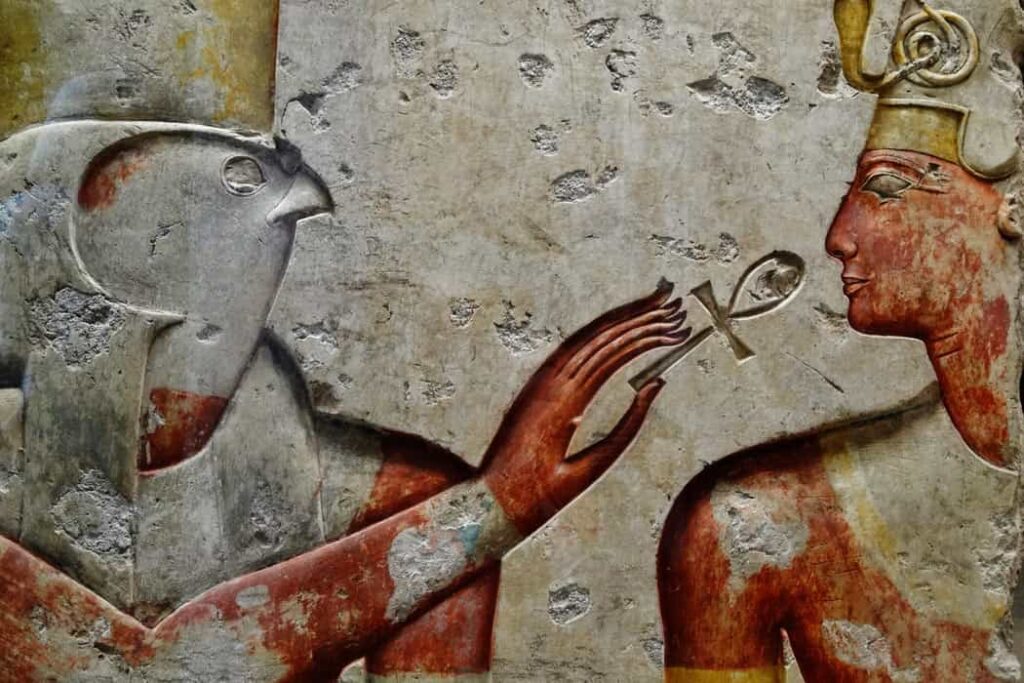
The ankh, one of ancient Egypt’s most recognizable symbols, represents life, vitality, and the promise of eternal existence. Often called the “Key of Life,” this distinctive hieroglyph features a cross-like shape topped with an oval loop. It appears throughout ancient Egyptian art, religious inscriptions, temple reliefs, and funerary objects.
But what did the ankh really mean to the ancient Egyptians, and why was it so closely associated with their gods, pharaohs, and beliefs about the afterlife?
Origins and Meaning of the Ankh
The ancient Egyptian word ankh means “life” or “to live.” As a hieroglyph, it was used in writing to express the concept of life and became one of the most powerful symbols in Egyptian religious and royal imagery.
Although the precise origin of its distinctive shape remains uncertain, the ankh was already in use during Egypt’s Early Dynastic Period (c. 3100–2686 B.C.). One of the earliest surviving examples appears on an Early Dynastic libation dish dating to approximately 3100–2900 B.C., now housed at the Metropolitan Museum of Art.
The ankh symbolized more than physical existence. It was closely associated with divine vitality, renewal, and the continuation of life beyond death.
The Ankh: A Symbol of Eternal Life
The ankh played an important role in ancient Egyptian beliefs about life, death, and rebirth. The Egyptians believed that life continued after physical death, and the ankh became a powerful expression of this hope for eternal existence.
Its frequent appearance in tombs, temples, and funerary objects reflects its connection to regeneration and the afterlife.
Rather than simply representing life on Earth, the ankh also expressed the divine power that sustained existence in both the mortal and spiritual worlds.
The Ankh in Ancient Egyptian Religion
Many ancient Egyptian gods and goddesses are depicted holding the ankh, particularly deities associated with creation, protection, death, and rebirth.
Gods such as Osiris, Isis, Ra, and Hathor frequently appear with this symbol in religious art.
Temple reliefs often show deities presenting the ankh to the pharaoh, symbolically granting him life and divine protection. These scenes emphasized the close relationship between the Egyptian king and the gods.
The ankh was not limited to royal imagery. It was also associated with divine power and the sacred forces that sustained the universe.
The Breath of Life: The Ankh Presented to the Nose
One of the most distinctive representations of the ankh appears in scenes where a god holds it close to the nose of a pharaoh.
This gesture symbolizes the gift of the “breath of life.” It expresses the belief that life and vitality came from the gods and could be bestowed upon the king through divine power.
This imagery became especially prominent in Egyptian temple decoration and royal representations. During the Amarna Period, for example, the rays of the Aten are depicted ending in hands that offer ankhs to Akhenaten, Nefertiti, and their daughters.
These scenes provide a remarkable illustration of the ankh’s religious significance.
The Ankh and Water: Purification and Renewal
Water was essential to ancient Egyptian ideas about creation, purification, and renewal. The ankh was sometimes incorporated into symbolic purification scenes in which gods pour streams of life-giving water over the king.
In these representations, the water may be depicted using alternating ankh and was-scepter signs, symbolizing the blessing of life, strength, and divine protection.
These scenes reinforce the connection between the ankh and the continuous renewal of life.
What Does the Ankh’s Shape Represent?
The precise origin of the ankh’s shape remains a subject of scholarly discussion. Several interpretations have been proposed over the years.
One widely discussed interpretation suggests that it represents a sandal strap, with the loop passing around the ankle and the lower portion extending along the foot.
Another interpretation connects its shape to a mirror or mirror case. Ancient Egyptian objects shaped like ankhs, including examples associated with mirrors, have contributed to this discussion.
However, no single explanation has been conclusively established as the original meaning of its shape.
Regardless of its origins, its written meaning is clear: life.
The Ankh in Amulets and Funerary Practices
The ankh was also used in ancient Egyptian jewelry and amulets. People wore ankh-shaped objects as expressions of their association with life and divine protection.
It also appeared in funerary contexts, where it symbolized the hope of continued existence in the afterlife.
Ankh amulets were sometimes placed in burials, including beside the deceased, reflecting the importance of eternal life in Egyptian funerary beliefs.
The symbol was also combined with other important Egyptian signs, particularly the djed pillar and the was scepter.
Together, these symbols expressed powerful concepts:
- Ankh: Life and vitality.
- Djed pillar: Stability and endurance.
- Was scepter: Power and dominion.
These combinations reflected the interconnected ideas of life, stability, and divine authority in ancient Egyptian religion.
The Ankh in Ancient Egyptian Art and Architecture
The ankh appears extensively in ancient Egyptian art, from monumental temple reliefs to statues, tomb paintings, jewelry, and everyday objects.
It is particularly recognizable in depictions of gods and pharaohs, who are frequently shown holding the symbol.
Its presence in religious architecture reinforced the connection between temples, divine power, and the preservation of life.
The ankh was also represented in different materials, including stone, gold, faience, and other substances used by Egyptian craftsmen.
The Ankh’s Legacy Beyond Ancient Egypt
The influence of the ankh continued beyond the end of ancient Egyptian civilization.
The symbol was later incorporated into Coptic Christian art in Egypt, where its distinctive looped shape was adapted into the crux ansata, or handled cross.
Today, the ankh remains internationally recognizable and appears in jewelry, fashion, artwork, and various spiritual traditions.
Although modern interpretations sometimes differ from its original Egyptian meaning, its historical association with life remains central to its identity.
Why Was the Ankh So Important to the Ancient Egyptians?
For the ancient Egyptians, the ankh was far more than a decorative hieroglyph. It represented one of the most fundamental concepts of their civilization: life itself.
From temple walls and royal monuments to funerary objects and personal amulets, the symbol expressed the divine gift of life, the promise of renewal, and the hope of existence beyond death.
Thousands of years later, the ankh remains one of the most enduring symbols of ancient Egypt, offering a fascinating glimpse into the civilization’s spiritual beliefs and its understanding of life and eternity.

