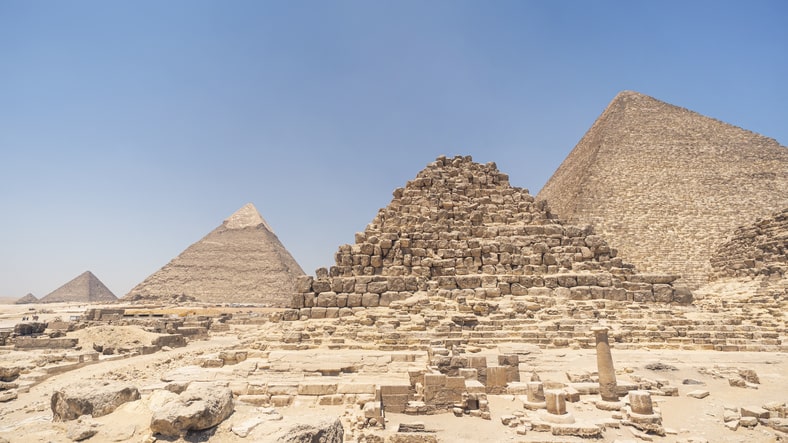
How many pyramids are there in Egypt? The answer may seem straightforward, but determining the exact number of Egyptian pyramids is more complicated than you might expect.
Although various estimates exist, historical complexities, archaeological discoveries, and disagreements over what qualifies as a pyramid make it difficult to establish a definitive total.
The pyramids are among the most iconic monuments of ancient Egyptian civilization. While the Great Pyramid of Giza and its neighboring pyramids are world-famous, hundreds of years of archaeological research have revealed numerous other pyramid structures, many of which receive far less attention.
Yet, despite extensive research, the exact number of Egyptian pyramids remains uncertain.
How Many Pyramids Are There in Egypt?
Some sources estimate that Egypt has approximately 118 pyramids, although this figure is not universally accepted. The disagreement stems partly from the difficulty of defining which structures should be included in the count.
According to Egyptologist Ann Macy Roth of New York University, determining the exact number is particularly challenging because scholars disagree about which monuments should be classified as pyramids. As reported by Live Science, there is no universally accepted total.
One complication involves the relationship between ancient Egypt and Nubia, a region that extended across parts of modern-day southern Egypt and Sudan.
During the 25th Dynasty, Nubian kings from the Kingdom of Kush ruled Egypt. The Kushite rulers also constructed pyramids in Nubia, particularly at sites in present-day Sudan.
However, whether these structures should be included in a count of Egyptian pyramids depends on the geographical and historical criteria being used. This distinction adds another layer of complexity to the debate.
Why Is Counting Egyptian Pyramids So Difficult?
Several additional factors make it challenging for archaeologists and Egyptologists to establish an exact total.
- Smaller Pyramids Are Sometimes Overlooked
Not all Egyptian pyramids are as impressive or well-preserved as those at Giza. Some are relatively small and receive considerably less attention.
For example, the so-called Queens’ Pyramids near the Giza pyramids are much smaller than the principal royal monuments. Some stand approximately 20 meters tall, although their dimensions vary.
These smaller structures are nevertheless important parts of ancient Egyptian funerary architecture. Their inclusion in a total count is generally less controversial than the classification of other, less clearly defined structures, but identifying and documenting every pyramid remains a challenge.
- Some Pyramids Were Never Completed
Another difficulty is that not every pyramid project reached completion.
Some ancient Egyptian rulers began constructing pyramids that were later abandoned, leaving behind unfinished structures or foundations. In such cases, archaeologists must determine whether the remains qualify as pyramids and whether they should be included in the overall count.
Mark Lehner, an Egyptologist and president of Ancient Egypt Research Associates (AERA), has highlighted the challenges involved in identifying and counting these monuments.
- Should Small Pyramids Inside Tombs Be Included?
The definition of an Egyptian pyramid can also influence the final number.
During the New Kingdom (c. 1550–1070 BCE), some private individuals incorporated small pyramid-shaped structures into their tombs. These monuments differed from the large royal pyramids built during earlier periods.
As Live Science has reported, their existence raises an important question: Should every small pyramid-shaped funerary structure be counted alongside the monumental pyramids built for kings and queens?
The answer depends on the criteria researchers use. A count that includes smaller funerary structures may differ considerably from one restricted to major royal pyramids.
Why Does the Exact Number Matter?
Establishing the number of Egyptian pyramids is not simply a matter of counting monuments. It also involves understanding how ancient Egyptian funerary architecture developed, how burial practices changed over time, and how different rulers and communities expressed their religious beliefs.
The uncertainty surrounding the total reflects the complexity of Egypt’s archaeological record rather than a lack of research.
Whether the final count is close to the commonly cited estimate of 118 or differs from it, the pyramids remain extraordinary evidence of the architectural knowledge, religious beliefs, and political power of ancient Egyptian civilization.
Thousands of years after their construction, these monuments continue to attract millions of visitors and inspire researchers around the world. Their enduring appeal is a reminder that even some of humanity’s most famous historical landmarks still hold questions waiting to be explored.