
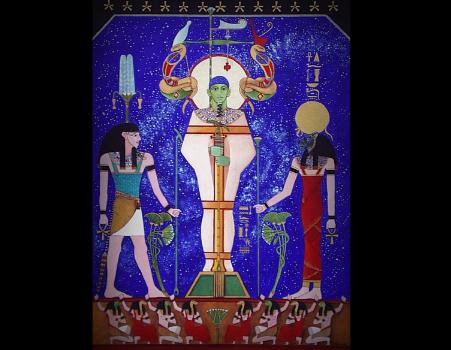
Ptah was one of the most important deities in ancient Egypt. As the patron god of Memphis, the capital of the Old Kingdom, he was revered as a creator god, the “Master Builder,” and the divine patron of architects, craftsmen, sculptors, and artisans.
According to Egyptian theology, particularly the Memphite Theology, Ptah created the world through the power of thought and speech. The ancient Egyptians believed that he conceived creation in his heart—considered the seat of intelligence—and brought it into existence through his spoken word. Because of this role, he was regarded as a supreme creator deity and was honored with titles such as “Lord of Truth,” “Lord of Magic,” and “He of the Beautiful Face.” The exact meaning of his name remains uncertain, although some scholars have suggested interpretations such as “The Opener.”
From the New Kingdom onward, Ptah formed the famous Memphite triad with his wife, Sekhmet, the lioness goddess of healing and warfare, and their son, Nefertum, the god of the lotus flower and rebirth.
Ptah is typically depicted as a mummiform man wrapped in a tight shroud, with only his hands visible. He wears a close-fitting skullcap and holds a composite scepter that combines three important symbols: the ankh (life), the djed pillar (stability and endurance), and the was-scepter (power and dominion). He often stands upon a pedestal symbolizing Maat, the cosmic order and balance that governed the universe.
One distinctive feature of Ptah’s iconography is his straight ceremonial beard, unlike the curved divine beard commonly worn by many other Egyptian gods.
As a funerary deity, Ptah became closely associated with Sokar and Osiris, forming the composite god Ptah-Sokar-Osiris, a powerful symbol of death, resurrection, and regeneration. He was also linked with other deities, including Tatenen, the personification of the primeval earth mound. In some traditions, Ptah and Tatenen were merged into a single deity representing creation and emergence from the primordial waters.
Egyptian texts describe Ptah as the divine architect who created the gods, founded cities, established temples, and assigned each deity a place of worship. Through his heart, tongue, and adherence to Maat, he brought order to the cosmos.
Ptah was associated with several major deities, including Ra, Amun, Sokar, Osiris, and Tatenen, although he did not fully merge with Ra or Amun in the same way that some Egyptian gods were combined into composite forms.
Ptah was especially revered as the patron of craftsmen, metalworkers, sculptors, builders, and goldsmiths. As the divine inventor of artistic and technical skills, he was particularly honored by the artisans of Deir el-Medina, the village that housed the workers responsible for constructing and decorating the royal tombs in the Valley of the Kings.
Several prominent Egyptians bore names honoring Ptah, including Ptahhotep, the renowned Old Kingdom vizier and sage, and Pharaoh Merneptah of the Nineteenth Dynasty.
Although his principal cult center was Memphis, Ptah was worshiped throughout Egypt. Temples dedicated to him existed at Karnak, where he had a sanctuary within the precinct of Amun, as well as at Thebes, Abydos, and various sites in Nubia.
Today, Ptah remains one of the most recognizable and influential gods of ancient Egyptian religion, embodying creation, craftsmanship, wisdom, and the sustaining order of the universe.


