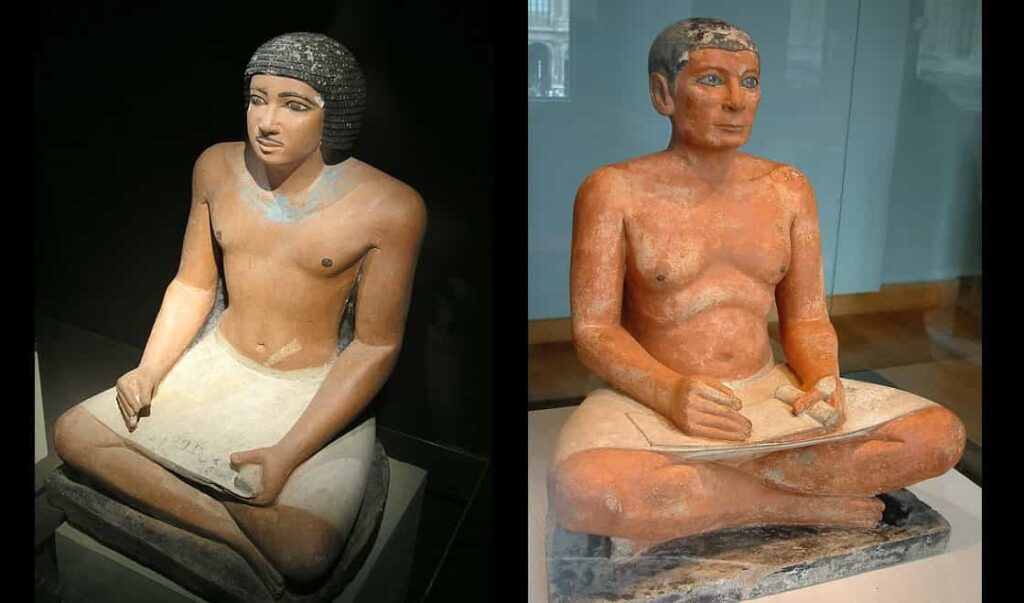
In ancient Egypt, few professions offered as much status and opportunity as that of a scribe.
The ability to read and write was highly valued in a society whose administration depended heavily on written records. Scribes documented economic transactions, managed accounts, recorded taxes and supplies, wrote letters and legal documents, and served in the administration, temples, and military. Yet literacy was limited to a small minority of the population.
Ancient Egyptian wisdom literature repeatedly praised the advantages of the scribal profession. One famous example is the Satire of Trades, in which a father named Dua-Khety contrasts the difficult lives of workers in various occupations with the advantages of becoming a scribe.
The message is clear: if you wanted a respected career, becoming a scribe was an attractive choice.
How did someone become a scribe?
Our knowledge of education in ancient Egypt is limited. Archaeological evidence shows that scribal training existed, but we cannot reconstruct a single standardized school system for the entire country. Writing boards, ostraca, papyri, and literary exercises provide glimpses into how students learned.
Children destined for a scribal career probably began their education at a relatively young age. They learned reading, writing, and basic mathematics before progressing to more specialized knowledge.
Learning to write was a demanding process. Students practiced copying texts repeatedly, gradually developing the ability to write quickly and accurately. They worked with hieratic—the cursive script commonly used for everyday documents for much of Egyptian history—as well as hieroglyphs, which were particularly important for monumental and religious inscriptions.
Students practiced on inexpensive materials such as limestone flakes and broken pieces of pottery known as ostraca, as well as wooden writing boards. Papyrus was more valuable and was used extensively for finished documents.
A typical scribal kit included a palette, brushes or rush pens, and cakes of black and red ink. Black ink was normally used for the main text, while red was used for emphasis, headings, and other important sections.
The curriculum included copying literary and wisdom texts, letters, administrative documents, lists, and other model compositions. Repetition helped students master both the mechanics of writing and the conventions expected of a professional scribe.
Some surviving exercises show just how much practice was required. The quality of a student’s handwriting could reveal their level of skill, while mistakes and corrections provide a fascinating glimpse into the learning process.
The famous Satire of Trades
One of the best-known works used in scribal education is the Satire of Trades, also known as the Teaching of Dua-Khety.
In the text, Dua-Khety takes his son Pepy to school while describing the difficulties associated with a variety of occupations. He presents the life of a scribe as comparatively comfortable and prestigious.
This was more than simple career advice. Such texts helped reinforce the cultural ideal of the educated official and encouraged students to value literacy, discipline, and learning.
The copying of literary works also helped preserve some of ancient Egypt’s most famous compositions. Texts such as the Story of Sinuhe survived in multiple copies, including manuscripts associated with scribal education. The survival of these works is closely connected to the copying practices of Egyptian scribes.
At the service of the state
The importance of scribes grew alongside the complexity of Egyptian administration.
From the Old Kingdom onward, scribes were involved in recording agricultural production, managing estates, documenting taxes and supplies, and maintaining administrative records. By the Middle and New Kingdoms, scribes could be found throughout the bureaucracy, including in government offices, temples, military institutions, and private households.
Their work could be highly specialized. Titles included scribes associated with particular institutions, offices, estates, and economic activities.
A scribe might record the amount of grain entering a granary, keep accounts for an estate, write correspondence, prepare legal documents, or accompany an official on an expedition.
The surviving documents of the Middle Kingdom official Heqanakht, for example, include letters and accounts dealing with land, grain, flax, servants, and household affairs. They provide a remarkable glimpse into how writing was embedded in everyday administration.
For talented individuals, literacy could therefore provide access to positions of responsibility and social advancement.
Under the protection of Thoth
Writing also had a powerful religious dimension.
The Greeks later called the monumental Egyptian script hieroglyphs, from Greek words meaning “sacred signs.” The Egyptians themselves used several terms for their writing; one well-known expression describes hieroglyphic signs as “divine words.”
The god Thoth, associated with writing, knowledge, wisdom, and intellectual activity, was regarded as the divine patron of scribes. He was commonly represented as an ibis or as a baboon and was closely associated with the city of Khmunu, later known to the Greeks as Hermopolis.
Thoth’s role extended beyond earthly scribes. In Egyptian religious tradition, he could act as a divine recorder and mediator, using his knowledge of writing and measurement to maintain cosmic and divine order.
Another important deity associated with writing was Seshat, the goddess of writing, record keeping, measurement, and the keeping of records. She was closely connected with Thoth and was depicted with her distinctive seven-pointed emblem.
Houses of Life
Some Egyptian temples contained institutions known as Houses of Life (Per-Ankh). These were associated with the production, copying, preservation, and study of texts, particularly religious and scholarly works.
They appear to have been important centers of intellectual activity, although our evidence does not support imagining them simply as schools in the modern sense.
Egyptian scribes were therefore much more than people who could read and write. They were administrators, accountants, record keepers, authors, copyists, and intellectuals whose work supported almost every major institution of Egyptian society.
For a young Egyptian seeking a respected profession, the message of the ancient texts was unmistakable:
Learn to write, and you could build a future.
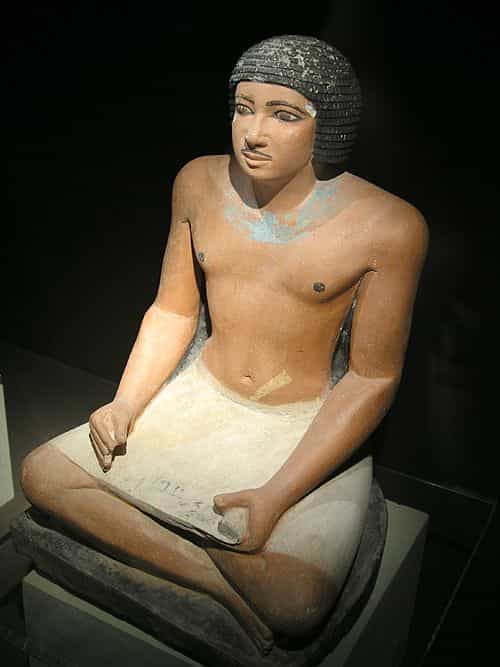
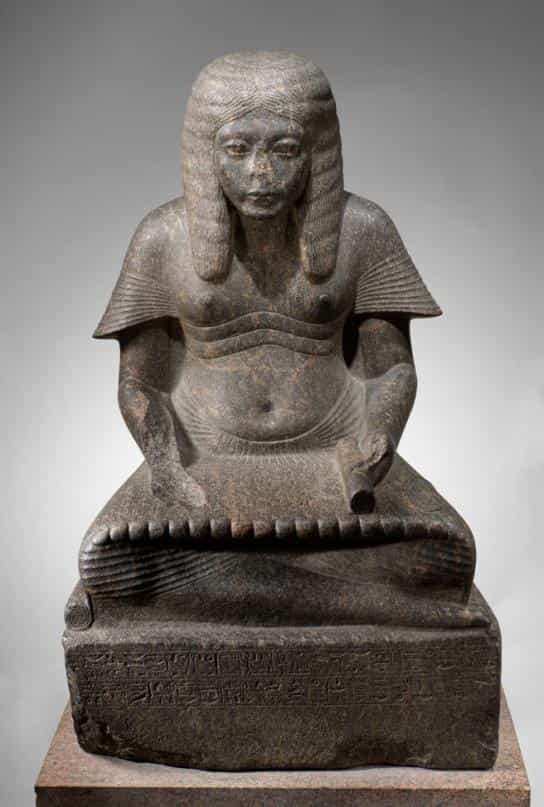
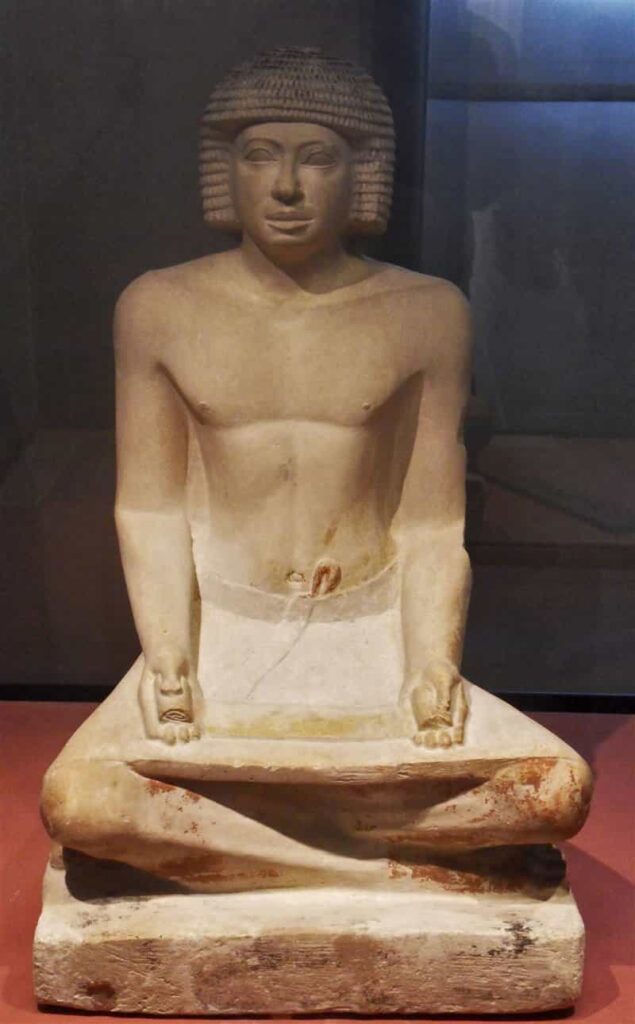
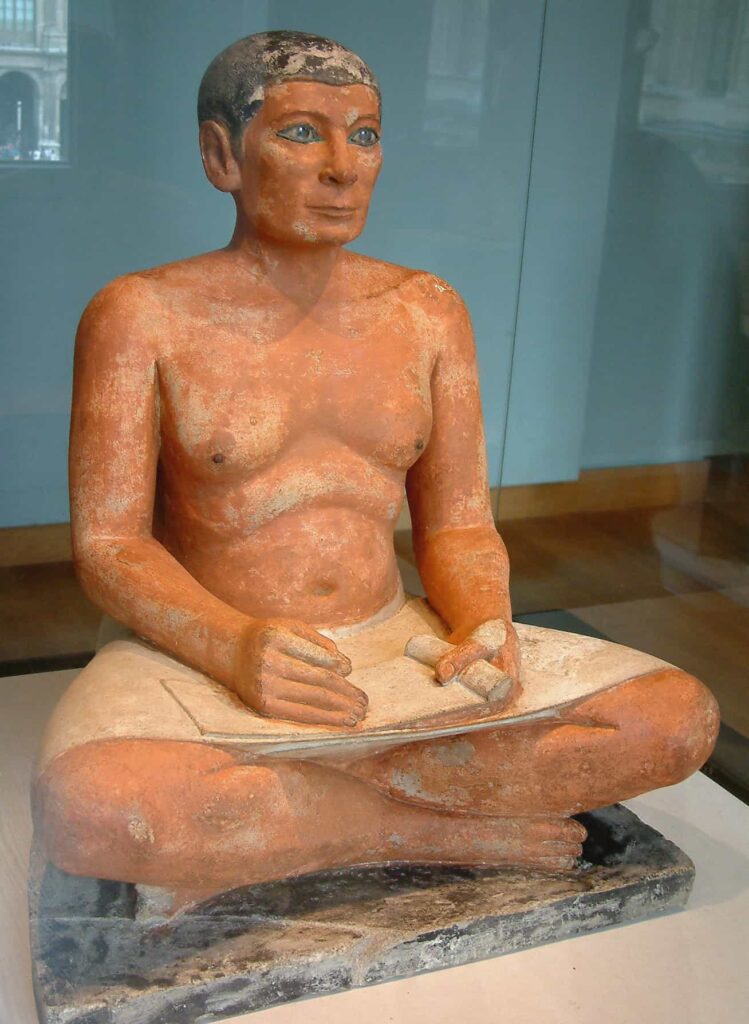
And perhaps that is why the image of the seated scribe—with a papyrus roll resting across his lap—became one of the most enduring symbols of educated status in ancient Egypt.