
The crowns of ancient Egypt were among the most recognizable symbols of royal authority, divine power, and kingship. Worn by pharaohs and depicted on gods and goddesses, these elaborate headdresses communicated the wearer’s status, religious associations, and connection to the Egyptian throne.
Ancient Egyptian crowns came in various shapes and designs, each carrying a particular symbolic meaning. Some represented the country’s two geographical regions, Upper and Lower Egypt, while others were associated with specific deities, religious ceremonies, or aspects of royal power.
Among the most important royal headdresses were the White Crown, the Red Crown, the Double Crown, the Atef Crown, and the Blue Crown. These can be seen in countless ancient Egyptian reliefs, paintings, and sculptures.
Let’s explore nine of the most distinctive crowns and headdresses of ancient Egypt and discover what they represented.
1- The White Crown (Hedjet)
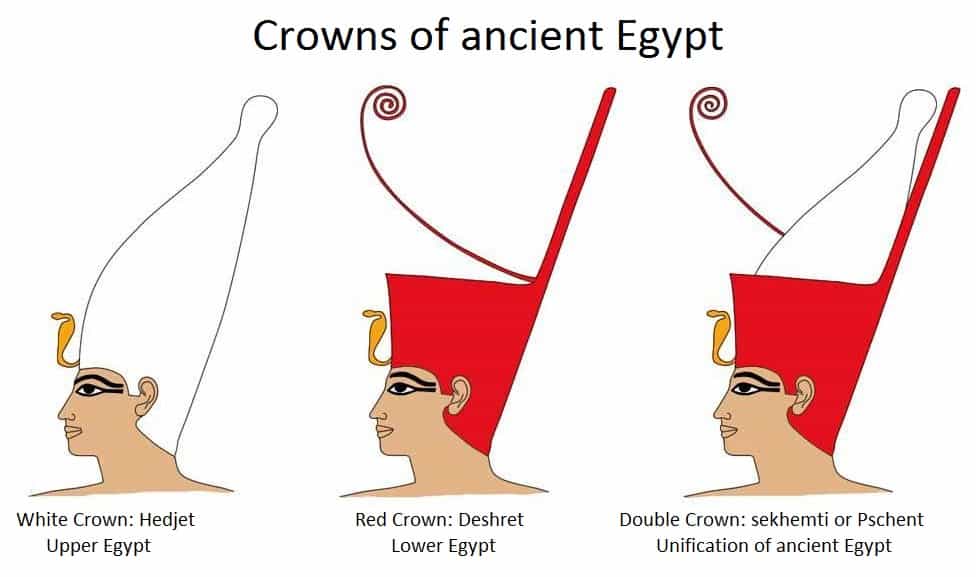
The White Crown, known as Hedjet, represented Upper Egypt, the southern region of the country. It was characterized by its tall, elongated shape, with a rounded top that narrowed toward its base.
The crown was closely associated with the goddess Nekhbet, the vulture goddess and divine protector of Upper Egypt. She frequently appeared wearing the White Crown, emphasizing her role as the region’s patron deity.
The Hedjet appears on some of the earliest royal representations in Egyptian history, including the famous Narmer Palette, dating to approximately 3100 BC.
Although its original material is unknown, it is generally believed to have been made from a relatively lightweight material, possibly cloth or plant fibers.
2- The Red Crown (Deshret)
The Red Crown, known as Deshret, represented Lower Egypt, the northern region encompassing the Nile Delta.
Its distinctive design consisted of a rounded base with a tall extension rising from the back and a thin, curled projection extending forward.
The crown was closely associated with Wadjet, the cobra goddess who protected Lower Egypt. She frequently appeared wearing the Red Crown and was one of the two principal protective goddesses of the Egyptian monarchy, alongside Nekhbet.
The Red Crown also had alternative ancient Egyptian names, including Net, a name associated with the goddess Neith.
Like the White Crown, the Deshret appears in early royal iconography and was an essential symbol of Egyptian kingship.
3- The Double Crown (Pschent or Sekhemty)
The Double Crown represented the unification of Upper and Lower Egypt under a single ruler.
Known to the ancient Egyptians as Sekhemty, meaning “the Two Powerful Ones,” it combined the White Crown of Upper Egypt with the Red Crown of Lower Egypt. The White Crown was placed inside the Red Crown, creating a distinctive double headdress.
The Greek term Pschent is the name by which this crown is commonly known today.
The Double Crown symbolized the pharaoh’s authority over the Two Lands and his responsibility for maintaining the unity of Egypt.
The famous Narmer Palette depicts King Narmer wearing both the White and Red Crowns on different sides, making it one of the earliest surviving representations of these royal symbols.
4- The Atef Crown
The Atef Crown was a distinctive ceremonial headdress particularly associated with Osiris, the ancient Egyptian god of the afterlife and resurrection.
It consisted of a central element resembling the White Crown, flanked by two tall ostrich feathers. Depending on the representation, it could also incorporate horns, a solar disk, and uraei (sacred cobras).
The crown was frequently depicted on Osiris, emphasizing his divine authority and association with death, resurrection, and regeneration.
It also appeared in royal and religious representations, connecting the pharaoh with divine power and the cycle of renewal.
5- The Hemhem Crown
The Hemhem Crown, also known as the Triple Atef Crown, was an elaborate variation of the Atef Crown.
Its design featured three White Crown-like elements, usually accompanied by ostrich feathers and other decorative components.
The name Hemhem is often translated as “the Roaring One.”
This elaborate crown was associated with solar symbolism, divine power, and renewal. It frequently appeared in representations of the king and certain deities, particularly in connection with the imagery of the sun’s rebirth.
6- The Blue Crown (Khepresh)
The Khepresh, commonly known as the Blue Crown, was a distinctive royal headdress frequently depicted on pharaohs during the New Kingdom.
It had the appearance of a rounded cap, often decorated with small circular elements arranged in a regular pattern.
Although it is popularly called the “War Crown,” its use was not limited to military activities. Pharaohs were also depicted wearing it during religious ceremonies, royal appearances, and scenes involving offerings to the gods.
Its exact material and construction remain subjects of scholarly discussion, although surviving representations show its characteristic blue color.
The Khepresh was also associated with royal power and the pharaoh’s divine authority.
7- The Shuti Crown (Two-Feather Crown)
The Shuti Crown was characterized by two tall feathers, often identified as falcon feathers, rising above the head.
Its design could become more elaborate through the addition of horns, a solar disk, or other decorative elements.
The two feathers were associated with divine and royal symbolism, and the crown appeared on various gods and goddesses.
During the New Kingdom, it became particularly prominent in representations of royal women and the Divine Adoratrices of Amun, important religious figures who held influential positions in the temples of Thebes.
8- The Nemes Headdress
Although not technically a crown, the Nemes was one of the most recognizable elements of ancient Egyptian royal regalia.
It was a striped cloth headdress worn by pharaohs, covering the head and falling over the shoulders in two distinctive front sections, known as lappets. At the back, the fabric was gathered and tied or folded into a characteristic form.
The Nemes is particularly famous today because it appears on the golden funerary mask of Tutankhamun.
On the mask, the headdress is decorated with alternating blue and gold stripes and is accompanied by the royal uraeus cobra and vulture, symbols of divine protection and kingship.
The Nemes could also be worn together with different crowns, making it an important part of the pharaoh’s royal appearance.
9- The Composite Crowns
In addition to the individual crowns, ancient Egyptian artists created elaborate combinations of different royal and divine symbols.
These composite headdresses could incorporate elements such as horns, ostrich feathers, solar disks, uraei, and other religious symbols.
Their designs changed over the centuries, reflecting the evolving religious beliefs and political traditions of ancient Egypt.
They were particularly prominent in temple reliefs and representations of gods and goddesses, where individual elements communicated specific divine attributes and associations.
The Symbolism of Ancient Egyptian Crowns
The crowns of ancient Egypt were much more than decorative royal accessories. They were powerful symbols of kingship, religious authority, and the relationship between the pharaohs and the gods.
The White and Red Crowns represented the two geographical regions of Egypt, while the Double Crown expressed the unity of the country under one ruler. Other headdresses, such as the Atef and Khepresh, communicated different aspects of divine and royal power.
Through their distinctive shapes, colors, and decorative elements, these royal symbols helped ancient Egyptians identify their rulers and understand the religious significance of their kingship.
Today, these remarkable headdresses remain among the most recognizable symbols of one of the world’s greatest ancient civilizations.