
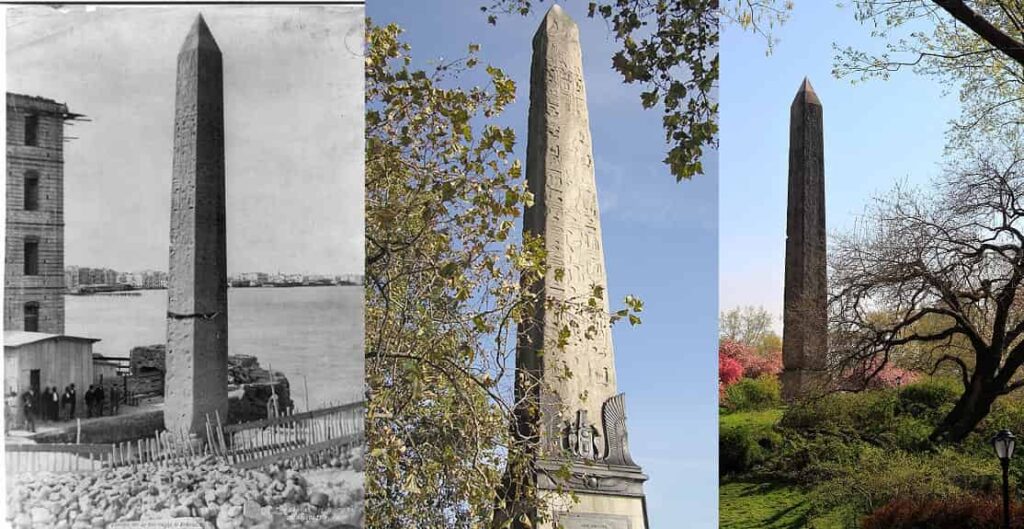
Few ancient Egyptian monuments have traveled as far from their original home as the pair of obelisks popularly known as Cleopatra’s Needles—one now standing in London and the other in New York City.
Despite their famous name, the obelisks have nothing to do with Cleopatra VII. They were originally erected at Heliopolis, the ancient Egyptian city of Iunu, during the reign of Thutmose III, around the mid-15th century B.C. The surviving obelisks were later inscribed by Ramesses II.
Around 12 B.C., during the reign of the Roman emperor Augustus, the pair was transported from Heliopolis to Alexandria, where the Romans re-erected them. Their association with Alexandria—and its connection with Cleopatra—eventually contributed to the later name “Cleopatra’s Needles.”
For centuries, the obelisks remained in Alexandria. In the 19th century, however, both were destined for new homes overseas.
Cleopatra’s Needle in London
In 1819, Egypt’s ruler Muhammad Ali Pasha presented one of the obelisks to the British government as a memorial to British victories over the French in Egypt, including Admiral Horatio Nelson’s victory at the Battle of the Nile in 1798 and Sir Ralph Abercromby’s victory at the Battle of Alexandria in 1801.
Although Britain accepted the gift, the government initially declined to pay for transporting the enormous monument to London. The obelisk therefore remained in Alexandria for decades.
In 1877, Sir William James Erasmus Wilson financed its transportation to Britain. The obelisk was enclosed in a specially designed iron cylinder and towed from Alexandria. During a severe storm in the Bay of Biscay, the vessel carrying it had to be abandoned, but the obelisk was eventually recovered and safely brought to Britain.
The monument was finally erected on Victoria Embankment in Westminster in 1878, where it still stands today.
Cleopatra’s Needle in New York
The other obelisk was given to the United States by Khedive Ismail Pasha and was transported from Alexandria to New York in 1880–1881. It was erected in Central Park in 1881, near The Metropolitan Museum of Art.
Today, both monuments remain remarkable examples of ancient Egyptian monumental architecture far from their original setting.
Carved from red granite quarried at Aswan, each obelisk stands roughly 21 meters (69 feet) high and weighs around 180 tons. Their inscriptions preserve the names and achievements of ancient Egyptian kings, connecting modern London and New York with the history of Egypt’s New Kingdom.


