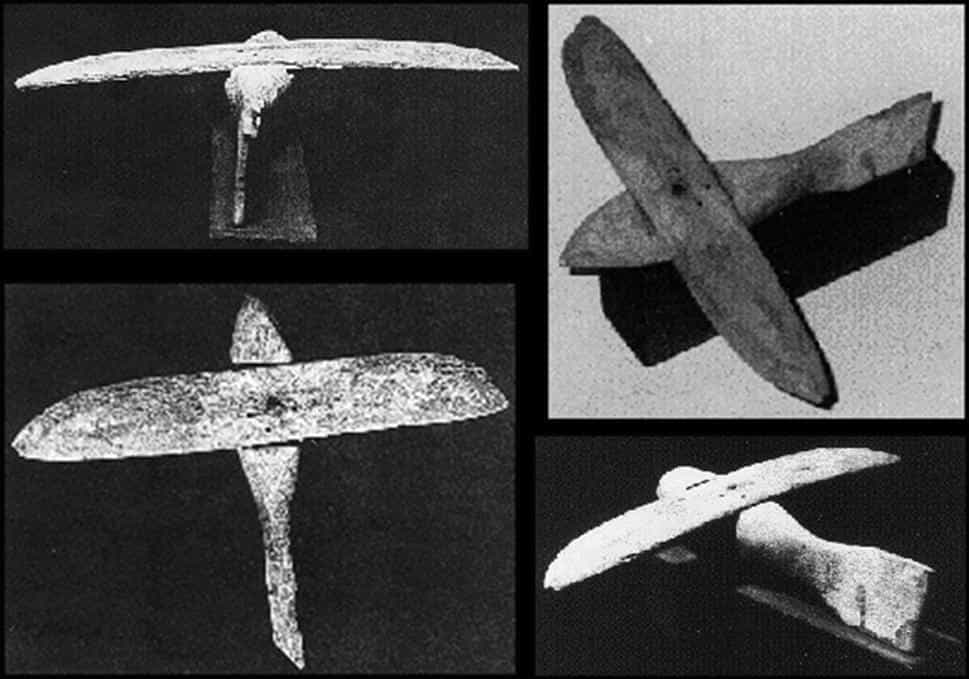
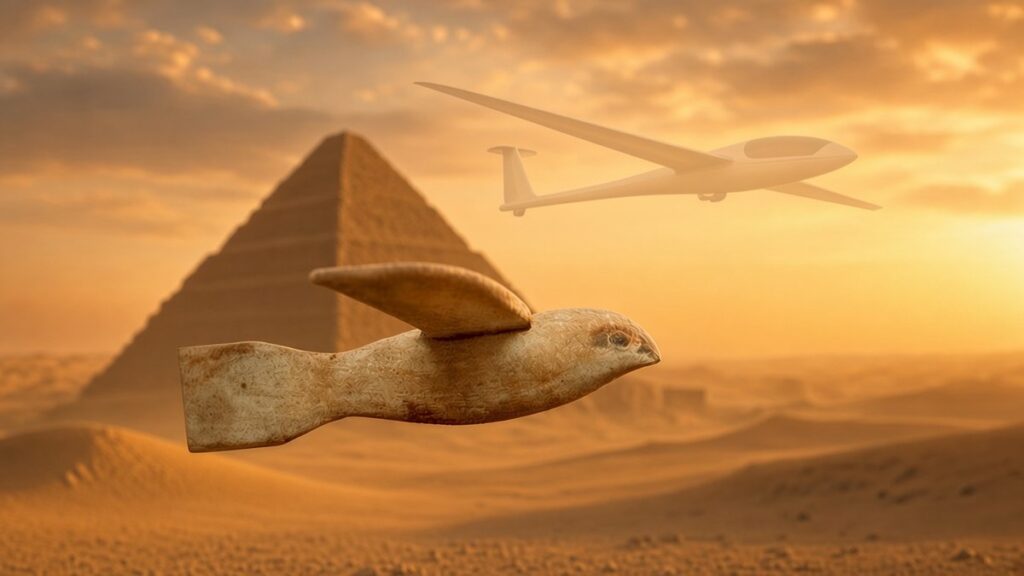
The Saqqara Bird, popularly known as the Saqqara Glider, is one of ancient Egypt’s most intriguing and debated artifacts. Carved from sycamore wood, this small bird-shaped object has a streamlined appearance that some people compare to a modern airplane.
Discovered in the ancient Egyptian necropolis of Saqqara in the late 19th century, the artifact has inspired a controversial question: Did the ancient Egyptians possess knowledge of aviation thousands of years before the invention of modern aircraft?
The object is now housed in the Egyptian Museum in Cairo and is generally dated to around 200 BC, during the Ptolemaic Period. Its original purpose remains uncertain, and it was initially classified as a cult object.
The Saqqara Bird measures approximately 15 cm in length, has a wingspan of about 18.3 cm, and weighs approximately 39 grams. It is carved in the shape of a bird, with features that have been compared to those of a falcon.
Conventional Theories: What Was the Saqqara Bird Used For?
Because there is little surviving documentation about the artifact, its original function remains unknown. Several explanations have been proposed over the years.
One suggestion is that it served as a ceremonial or religious object. Its bird-like appearance, particularly its resemblance to a falcon, may have had symbolic significance. The falcon was closely associated with several ancient Egyptian deities, most notably Horus, one of the most important gods in Egyptian religion.
Other theories suggest that the object may have been a toy belonging to an upper-class child, a decorative figure, a weathervane, or even a type of throwing stick similar to the boomerangs used in ancient Egypt for hunting waterfowl.
However, none of these interpretations has been conclusively established.
Similar Bird Figures on Ancient Egyptian Ships
Another interesting interpretation connects the Saqqara Bird with bird-shaped ornaments mounted on the masts of ancient Egyptian ceremonial ships.
Reliefs in the Temple of Khonsu at Karnak, dating to the late New Kingdom, depict ships associated with religious festivals, including the Opet Festival. Some of these vessels feature bird-shaped figures mounted on their masts.
The reliefs show vessels associated with different rulers and periods, including a ship of Ramesses III, one from the reign of Herihor, and another associated with Mery-Amun.
These representations have led to the suggestion that the Saqqara Bird may have served a similar decorative or ceremonial purpose.
The Controversial Theory: Was the Saqqara Bird an Ancient Glider?
The most controversial interpretation emerged when Egyptian physician and researcher Khalil Messiha drew attention to the artifact’s unusual shape.
Messiha believed that the object was not simply a representation of a bird but a scale model of an ancient flying machine.
In his research, published in 1983, he argued that its streamlined body, wings, and upright tail resembled the design of a modern monoplane.
He suggested that the object might have functioned as a glider if it had been fitted with a horizontal stabilizer at the rear. He proposed that this component might have been lost over time.
Messiha also argued that the absence of legs and the unusual arrangement of the wings distinguished the artifact from conventional ancient Egyptian bird figurines.
According to his interpretation, these features could indicate an attempt to create a model capable of aerodynamic lift.
His theory attracted considerable attention and helped turn the Saqqara Bird into one of the most frequently discussed examples of supposed advanced technology in the ancient world.
Was the Saqqara Bird an Ancient Egyptian Glider?
The idea that the Saqqara Bird was an ancient Egyptian glider comes from its unusual shape.
Its straight wings and lack of legs led Egyptian physician Khalil Messiha to propose that it was a scale model of a glider, possibly missing a horizontal tail stabilizer.
However, a 2023 aerodynamic study by Michel Zierow and Leon Lesemann found that the model lacked the stability required for controlled flight. Moreover, no archaeological evidence has been discovered to demonstrate that the ancient Egyptians built flying machines.
Could the Saqqara Bird Actually Fly?
Despite the fascination surrounding Messiha’s theory, there is no convincing archaeological evidence that the ancient Egyptians developed aircraft or flying machines.
A 2023 scientific study by Michel Zierow and Leon Lesemann examined the aerodynamic properties of the Saqqara Bird using a three-dimensional model and computer simulations.
Their investigation found that the artifact had poor aerodynamic stability. Its center of gravity and uneven lift distribution would make controlled flight difficult, preventing it from maintaining a stable, straight trajectory.
The researchers concluded that their findings did not support the theory that the artifact was evidence of ancient Egyptian knowledge of aerodynamics.
Furthermore, no ancient Egyptian aircraft, technical drawings of flying machines, or other archaeological evidence demonstrating the existence of such technology have been discovered.
Conclusion: The Mystery of the Saqqara Bird
The Saqqara Bird remains a fascinating artifact from ancient Egypt. Although its unusual shape continues to inspire speculation about ancient aviation, there is no reliable evidence that it was designed as a flying machine.
Its original purpose is still uncertain, and explanations involving religious symbolism, decoration, or other practical uses remain possibilities.
For now, the Saqqara Bird is best understood as an intriguing archaeological object whose true function has yet to be established.
Frequently Asked Questions
The Saqqara Bird, popularly known as the Saqqara Glider, is a small sycamore-wood figure carved in the shape of a bird, with features compared to those of a falcon. It is generally dated to around 200 BC, during the Ptolemaic Period, and was initially classified as a cult object.
It was discovered in the ancient Egyptian necropolis of Saqqara in the late 19th century. The artifact is now housed in the Egyptian Museum in Cairo.
There is no convincing archaeological evidence that the ancient Egyptians developed aircraft or flying machines. A 2023 study also found that the Saqqara Bird had poor aerodynamic stability, and the researchers concluded this did not support claims of ancient Egyptian knowledge of aerodynamics.
In 1983, Egyptian physician and researcher Khalil Messiha argued that the object was a scale model of an ancient flying machine and might have worked as a glider if a lost rear stabilizer had been present. Later research did not support that interpretation, and the artifact's original purpose remains uncertain.