
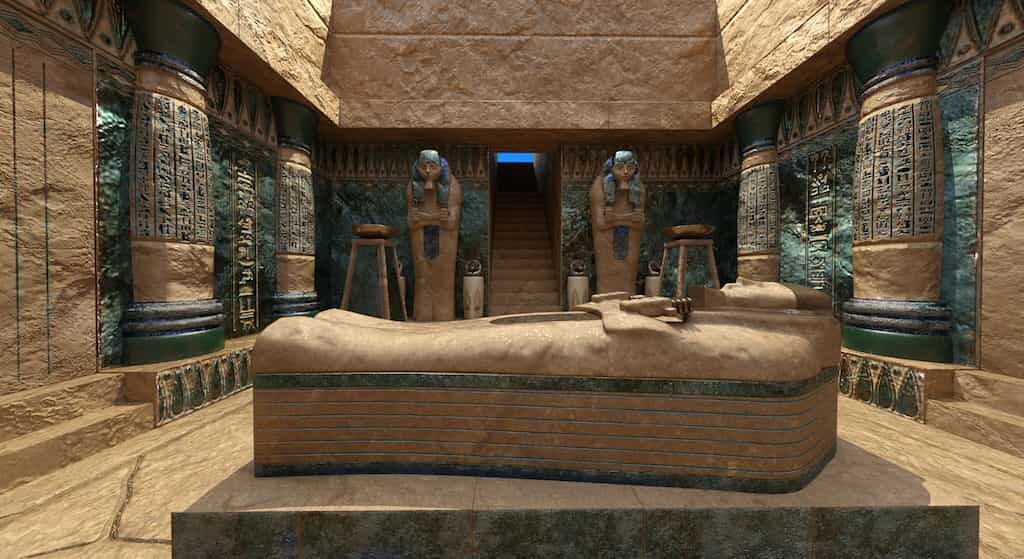
Many people think of the Egyptian pyramids as mysterious, empty monuments. In reality, they were built as royal tombs for Egypt’s pharaohs.
One of the most common misconceptions about Ancient Egypt is the claim that archaeologists have never discovered mummies inside the pyramids—only scattered human remains. While intact royal mummies from the pyramid age are rare, archaeological evidence clearly shows that pyramids served as burial places for kings and members of the royal family.
From the Third through the Twelfth Dynasty, Egyptian rulers and many of their relatives were buried in pyramids. Although few mummies have survived intact, archaeologists have recovered human remains from several pyramid burials, including those of royal individuals.
Why So Few Mummies Have Survived
There are several reasons why so few pyramid burials remain today.
Unlike hidden rock-cut tombs, pyramids were highly visible landmarks, making them attractive targets for tomb robbers throughout antiquity. Over thousands of years, looters repeatedly entered these monuments, stealing precious funerary goods and often damaging or destroying the bodies they contained.
Another reason is that mummification was still developing during the Old and Middle Kingdoms. Embalming techniques became far more sophisticated during the New Kingdom, more than a thousand years later. As a result, earlier mummies were generally less well preserved.
It is also important to remember that ancient Egyptian civilization lasted for over 3,000 years. Cleopatra VII lived closer in time to the opening of the first McDonald’s restaurant than to the construction of the Great Pyramid of Giza—a reminder of the immense span of Egyptian history.
Modern excavations also contributed to the loss of evidence. During the nineteenth and early twentieth centuries, some treasure hunters and even early Egyptologists focused primarily on artifacts rather than human remains. In some cases, mummies deteriorated through improper handling or inadequate storage.
Today, every mummy discovery is treated as an invaluable scientific resource. Advances in archaeology, conservation, and medical imaging have transformed the way researchers study ancient human remains.
One notable example is the French archaeologist Émile Amélineau (1850–1915), who excavated the tomb of King Khasekhemwy at Abydos. He discovered two skeletons, but their condition was so fragile that they disintegrated during excavation. Amélineau later wrote:
“I carefully collected all the bones. Unfortunately, when we attempted to handle those of the first skeleton, they crumbled. The skeleton came apart, and the skull split. When I took them to Cairo for examination, the specialist told me they were in too poor a condition to study.”
The current whereabouts of those remains are unknown.
Mummies and Human Remains Found in Egyptian Pyramids
The earliest pyramid, the Step Pyramid of King Djoser at Saqqara, has yielded human remains. During excavations, the French architect and archaeologist Jean-Philippe Lauer discovered a rib, a humerus, a left foot, and soft tissue inside Djoser’s granite sarcophagus. Scientific analysis later showed that these remains belonged to several individuals who lived after Djoser’s reign, meaning they were not the king’s own remains.
The same pyramid complex also contained the skull of a young royal woman, believed to have died around the age of sixteen or seventeen. Although her exact identity remains unknown, she represents one of the earliest known members of the royal family found buried within a pyramid complex.
Lauer also discovered the remains of a young child in the unfinished Step Pyramid of King Sekhemkhet in 1966, though the child’s identity remains uncertain.
The Red Pyramid at Dahshur, built by King Sneferu, has produced fragmentary mummified human remains that may belong to the king, although their identification remains uncertain. Sneferu was the father of King Khufu, builder of the Great Pyramid of Giza. Khufu’s mummy has never been found.
One important discovery from the Fourth Dynasty is the mummified internal organs of a queen, recovered from one of the subsidiary pyramids associated with Sneferu’s complex.
The strongest evidence comes from the Fifth Dynasty. In 1997–1998, archaeologists discovered the remains of King Neferefre within his unfinished pyramid at Abusir, providing direct evidence that pyramids functioned as royal tombs.
Another remarkable discovery is a well-preserved female mummy found in the pyramid complex of King Nyuserre at Abusir. Many Egyptologists believe she may be Queen Reputnub, although her identification has not been confirmed.
These discoveries, together with numerous inscriptions, sarcophagi, burial equipment, and human remains, leave little doubt that Egyptian pyramids were constructed as royal tombs. Although intact royal mummies from the pyramid age are rare, archaeology has repeatedly confirmed the funerary purpose of these monumental structures.
Sources
- Frank Navarro, Muy Historia.
- José Miguel Parra, Mummies: The Defeat of Death in Ancient Egypt (Editorial Crítica, 2010).