
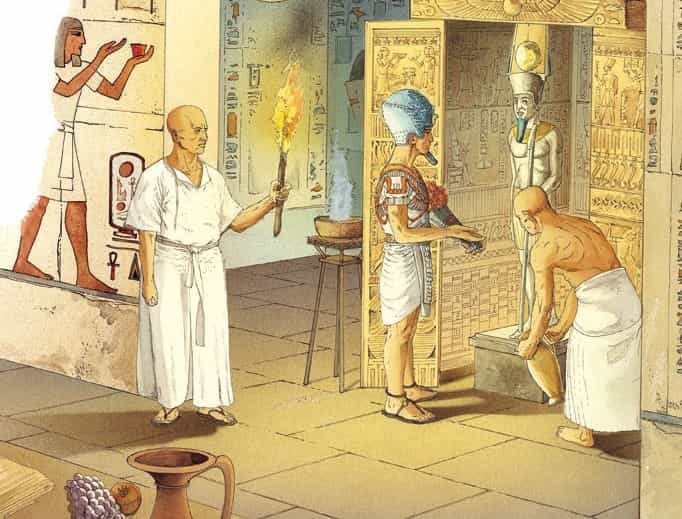
The priesthood of ancient Egypt was a complex and well-organized institution responsible for maintaining religious worship and performing rituals dedicated to the many gods and goddesses of the Egyptian pantheon.
Priests played an essential role in Egyptian society. They served in temples, performed sacred ceremonies, maintained cult statues, administered temple estates, and helped preserve the cosmic order upon which the ancient Egyptians believed the world depended.
But what exactly did priests do, how were they organized, and what was their daily life like?
The Role of Priests in Ancient Egypt
The ancient Egyptians believed that the gods had established the world and maintained its harmony through Maat, the principle of truth, justice, balance, and cosmic order. This divine harmony had to be preserved every day so that life could continue and the forces of chaos could be kept at bay.
The pharaoh, regarded as the gods’ earthly representative, was ultimately responsible for maintaining Maat and ensuring the continued relationship between the divine and human worlds.
In royal ideology, the king was the principal intermediary between the gods and humanity. However, maintaining divine harmony required daily religious ceremonies throughout Egypt’s many temples. Since the pharaoh could not personally perform every ritual, he delegated these responsibilities to priests, who carried out the ceremonies on his behalf.
Their primary responsibility was to serve the gods through daily offerings, prayers, purification rites, and other sacred ceremonies. They also managed temple activities and ensured that the religious institutions continued to function.
Some priests, particularly lector priests, were also specialists in sacred texts, ritual recitations, and magical practices. Their knowledge could be used in temple ceremonies, funerary rituals, and protective rites.
The Hierarchy of the Ancient Egyptian Priesthood
The ancient Egyptian priesthood was organized into a hierarchy of religious offices and responsibilities. Each major temple had its own priestly organization dedicated to the worship of its principal deity.
Although the pharaoh was theoretically the highest religious authority, he appointed senior priests to oversee important temples and supervise their religious and administrative affairs.
Some priestly positions were inherited within families, passing from father to son, while others were granted through royal appointment or promotion.
Priests held considerable social status, particularly those serving in major religious centers such as Karnak and Heliopolis. Their responsibilities extended beyond religious ceremonies to include the administration of temple lands, property, workshops, and resources.
Temples also preserved religious and scholarly knowledge through their collections of sacred and administrative texts.
The Different Ranks and Duties of Priests
The priesthood included several ranks and specialized roles, each with particular responsibilities.
Among the most important were:
- High Priests
High priests occupied the highest positions within individual temples. They supervised religious ceremonies, managed temple affairs, and oversaw the work of other priests.
Some held influential positions because of their close connections to the pharaoh and the royal administration.
- Lector Priests
Lector priests were specialists in religious texts and ritual recitations. Their name is commonly translated as “the one who carries the ritual book.”
They recited sacred spells, prayers, and invocations during temple ceremonies and funerary rituals. They could also perform protective magical rites.
- Wab Priests (Pure Priests)
The term wab means “pure.” These priests were responsible for performing purification rites and assisting with various temple ceremonies.
They helped prepare ritual equipment, handle offerings, and carry out duties connected with the service of the gods.
- Priests with Astronomical and Timekeeping Duties
Some temple personnel observed the movements of celestial bodies and used their knowledge to determine the appropriate times for religious ceremonies.
Others were responsible for measuring the hours of the day and night, helping ensure that rituals took place at the proper times.
- Priests and Specialists in Divination and Healing
Certain religious specialists were involved in interpreting dreams, identifying favorable and unfavorable days, performing protective rituals, and treating illnesses.
The boundaries between religious practice, medicine, and magic were not the same in ancient Egypt as they are today.
Daily Life and Responsibilities of Ancient Egyptian Priests
The daily routine of a priest depended on his rank, responsibilities, and the temple in which he served.
Priests were responsible for much more than performing religious ceremonies. They also maintained temple buildings, supervised offerings, managed resources, and ensured that sacred objects were properly cared for.
Many priestly positions operated on a rotational basis. In some temples, priests were divided into groups known as phyles, which took turns serving the deity. These groups could work for a limited period before another group took over.
This arrangement allowed priests to maintain their other responsibilities outside the temple while ensuring that religious services continued throughout the year.
Purification and Personal Cleanliness
Purity was essential to the performance of sacred duties.
Before entering restricted areas of a temple or participating in religious ceremonies, priests had to undergo ritual purification. This could involve bathing, washing, and observing specific rules concerning cleanliness.
Some priests shaved their heads and removed their body hair as part of their purification practices. They also followed dietary and other purity regulations, although the exact requirements varied across periods and priestly offices.
Caring for the Gods’ Statues
One of the most important responsibilities of temple priests was caring for the cult statue of the deity.
The ancient Egyptians believed that the god’s divine presence could inhabit the cult statue housed within the temple sanctuary.
Each morning, priests performed a series of rituals to awaken and serve the deity. These ceremonies included opening the shrine, presenting offerings, purifying and anointing the statue, and dressing it in clean garments.
Food, drink, incense, and other offerings were presented to the god as part of the daily ritual.
After the ceremonies, the statue was returned to its shrine, and the sanctuary was closed.
These rituals were repeated every day to maintain the relationship between the gods and the human world.
Women in the Ancient Egyptian Priesthood
Women also participated in the religious life of ancient Egypt, although their opportunities and positions varied considerably across different periods and temples.
Many women served as singers, musicians, and dancers during religious ceremonies. They were particularly associated with the worship of goddesses such as Hathor.
Among their religious titles were ḥesyt (female singer) and other designations associated with music and temple performance.
One of the most influential religious positions held by women was the God’s Wife of Amun, also known as the Divine Adoratrice of Amun.
This position became particularly powerful during the Third Intermediate Period and the Late Period. Its holders were often women of royal lineage, including daughters of kings, who exercised considerable religious and political influence, especially at Thebes.
Although men dominated many priestly offices, women’s participation was an important part of ancient Egyptian religious life.
Religious Rituals and Ceremonies
The priests began their daily religious service with ritual purification, which often involved bathing and washing before entering the sacred areas of the temple.
They then proceeded to the sanctuary, where they performed the morning ritual of awakening and serving the deity.
The ceremonies generally involved opening the shrine, presenting offerings, burning incense, purifying and anointing the cult statue, and dressing it in clean garments.
Food and drink were also presented to the god. These offerings were later removed from the sanctuary and could be distributed among temple personnel.
Other ceremonies took place throughout the day, including prayers, purification rites, and special offerings. During religious festivals, priests also participated in processions in which the deity’s cult statue was carried in a sacred barque outside the temple sanctuary.
These rituals were essential to Egyptian religious beliefs. By performing them, priests helped maintain Maat and protect the world from the forces of chaos.
Life as an ancient Egyptian priest was therefore a combination of religious service, ritual purification, administrative responsibilities, and specialized knowledge. Through their daily work, priests helped preserve the religious traditions and institutions that remained central to Egyptian civilization for thousands of years.
