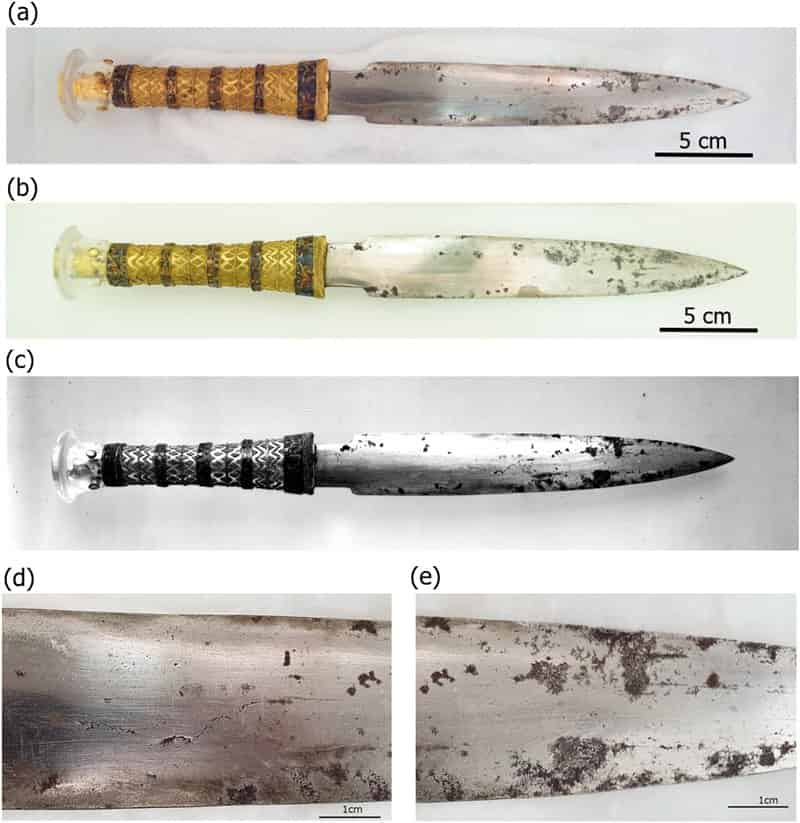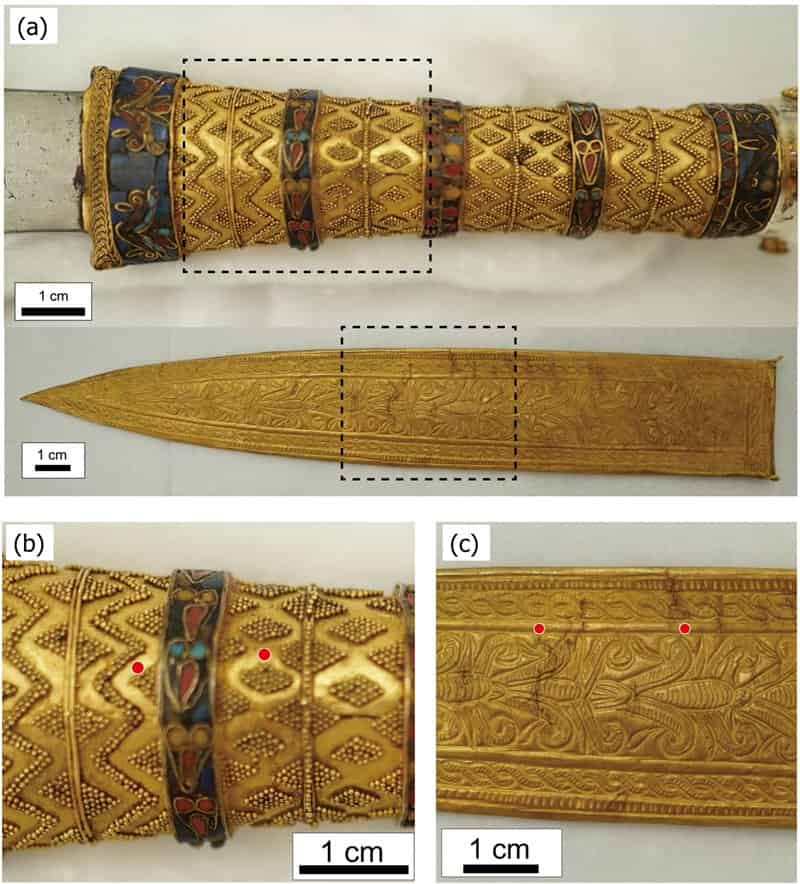
“Next to the kilt, alongside the right thigh, and, in my opinion, part of the same girdle as the kilt, there lay a unique and extraordinary dagger, sheathed in a gold scabbard.
Its hilt was made of granulated gold, embellished at intervals with bands of colored rock crystal.
However, the most astounding and exceptional feature of this beautiful weapon is that its blade was crafted from iron, still gleaming and steel-like.”
These words reflect the astonishment of Egyptologist Howard Carter when he discovered Tutankhamun’s tomb in the Valley of the Kings in 1922. Among the bandages wrapped around the young pharaoh’s mummy was a remarkable iron dagger, carefully placed as if it were one of his most treasured possessions.
This extraordinary weapon, found alongside a second dagger with a gold blade, measures nearly 14 inches (35 cm) in length. Scientific analysis revealed that its iron blade contains approximately 11% nickel and 0.6% cobalt—strong evidence that the metal originated from a meteorite.
In 2016, researchers confirmed the extraterrestrial origin of the dagger through a detailed chemical analysis. Yet many questions remained unanswered, particularly regarding where and how the weapon was forged.
A more recent study conducted by researchers from the Chiba Institute of Technology in Japan, led by Takafumi Matsui in collaboration with Egyptian experts, reaffirmed the meteoritic origin of Tutankhamun’s famous dagger. The study also provided evidence suggesting that the weapon was forged outside Egypt.
Published in Meteoritics & Planetary Science, the research analyzed the distribution of nickel across the dagger’s surface using non-destructive X-ray technology. The results indicated that the metal had been heated at relatively low temperatures, between 1,470°F and 1,740°F (800–950°C).
This conclusion is supported by the presence of so-called Widmanstätten structures—distinctive crystalline patterns found in meteoric iron. These structures disappear when heated to temperatures of 1,832°F (1,000°C) or higher, suggesting that the blade was forged without reaching extreme temperatures.
The study further determined that the iron came from a type of iron meteorite known as an octahedrite. Researchers also detected traces of sulfur, zinc, and chlorine within the blade.
A Diplomatic Gift for the Pharaoh?
If the dagger was not forged in Egypt, where did it come from? Could it have been a diplomatic gift from a foreign ruler?
To answer this question, researchers turned to the famous Amarna Letters—a collection of clay tablets discovered at Amarna, the capital established by Pharaoh Akhenaten (r. c. 1353–1336 BC). These tablets preserve diplomatic correspondence between the Egyptian court and neighboring kingdoms.
One of the letters records that Amenhotep III (r. c. 1390–1353 BC), Tutankhamun’s grandfather, received an iron dagger as a gift from King Tushratta of Mitanni.
According to the researchers, iron-working technology and the use of lime plaster were already well established in both the Mitanni and Hittite regions at that time. The Amarna Letters may therefore provide evidence that Tutankhamun’s meteoritic iron dagger was imported from outside Egypt.
The exceptional craftsmanship of the weapon also suggests that ancient metalworkers had already developed sophisticated techniques for working meteoric iron more than 3,300 years ago.
Today, Tutankhamun’s meteoritic iron dagger remains one of the most fascinating artifacts from ancient Egypt—a weapon literally forged from material that fell from the sky.