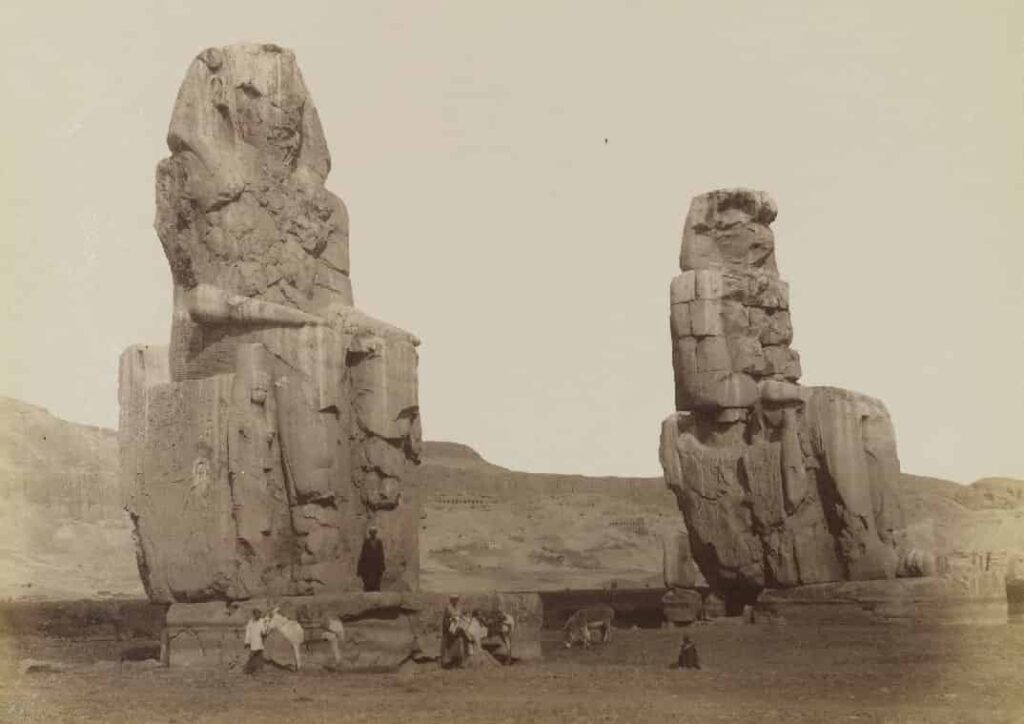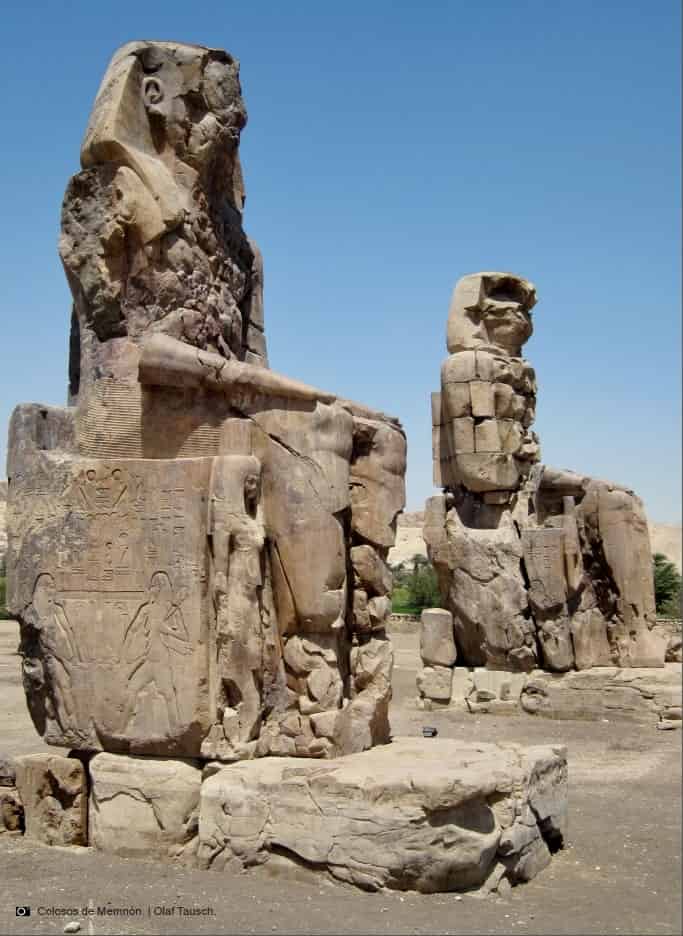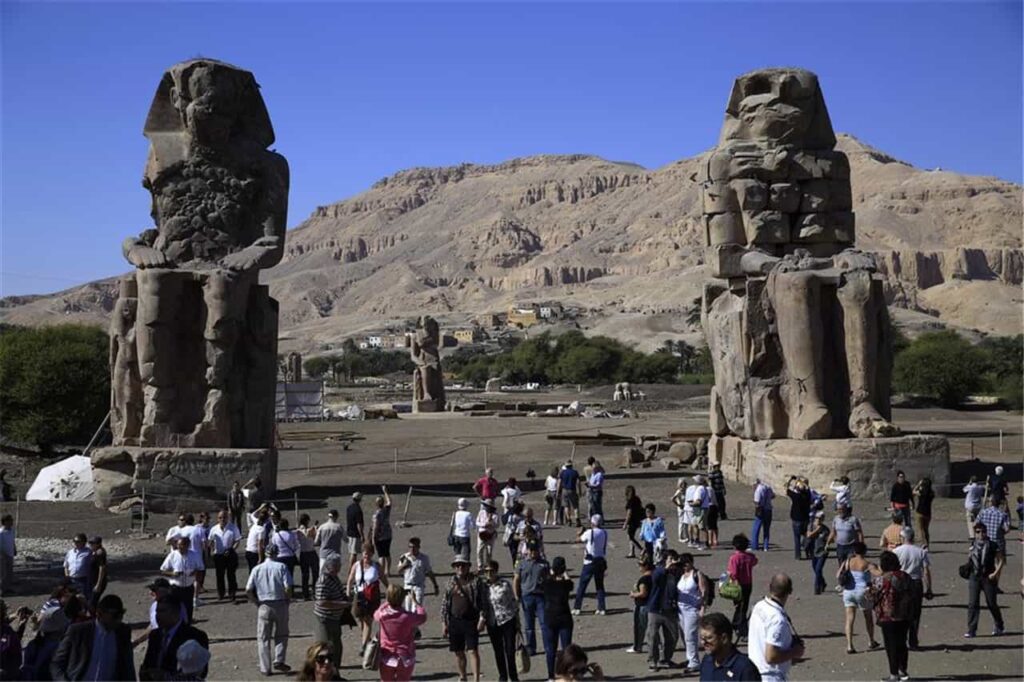
The Colossi of Memnon, situated on the western bank of ancient Thebes (Waset), once marked the entrance to the Temple of Millions of Years of Amenhotep III.
Forming part of the funerary temple of one of ancient Egypt’s greatest pharaohs, the colossi have a history and legend of their own—one that made them famous far beyond the borders of the Two Lands.
The History of the Colossi of Amenhotep III
Although they now appear fragmented and weathered, both colossi were carved from single blocks of quartzite, believed to have been quarried at Gebel el-Ahmar near modern Cairo, about 20 kilometers (12 miles) northeast of ancient Memphis.
The impressive statues represent Amenhotep III, the ninth pharaoh of the Eighteenth Dynasty, who reigned from approximately 1391 to 1353 BC. In ancient times, they stood at the entrance to his vast funerary temple, which extended for nearly 1 kilometer.
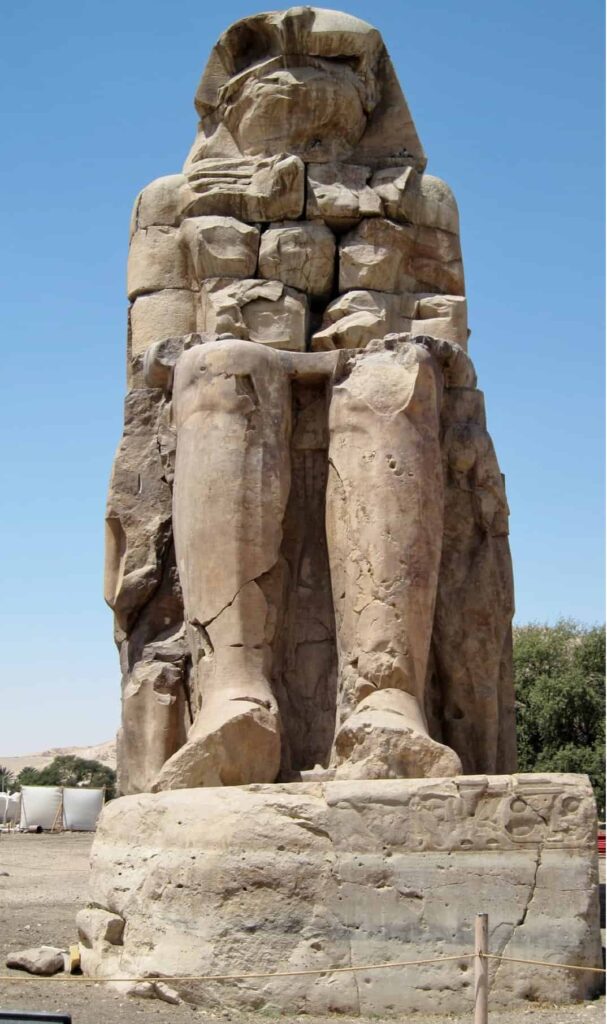
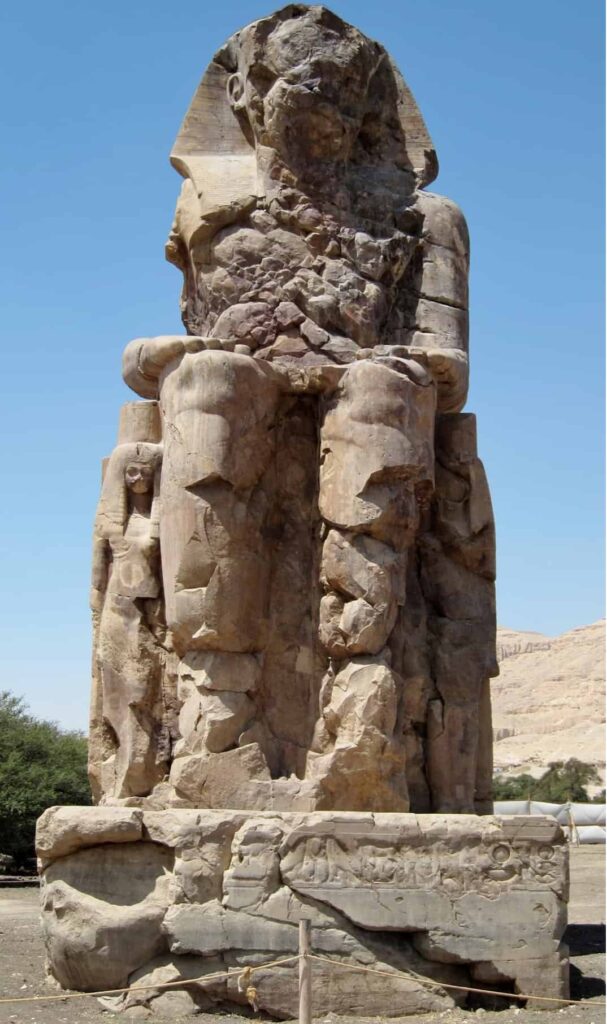
The colossi are nearly 20 meters (65 feet) high and weigh approximately 720 tons each. They depict the king seated on a throne, with his hands resting on his legs, wearing the nemes headdress and a pleated royal kilt.
Beside the legs of the northern colossus are representations of several members of Amenhotep III’s family. The smaller figure on the right is generally identified as Mutemwiya, the king’s mother. The southern colossus depicts Amenhotep III accompanied by his wife, Queen Tiye, and one of their daughters, whose identity remains uncertain.
On the sides of the throne are representations of Hapi, the god associated with the Nile flood, shown binding together the symbols of Upper and Lower Egypt—the lotus and papyrus—in a motif known as sema-tawy, symbolizing the unification of the Two Lands.
The creation of the colossi has been associated with a sculptor named Men, who is described in an inscription as the “chief sculptor of the great monument of the king on the red mountain.”
What Happened to the Temple of Amenhotep III?
We still have the colossi, but what happened to the enormous temple they once guarded?
The Temple of Millions of Years of Amenhotep III was one of the largest and most impressive funerary temples ever built at Thebes. Much of its construction consisted of stone and mudbrick.
Its location in the floodplain of the Nile contributed to its deterioration. The annual flooding gradually damaged the mudbrick structures, while the temple also suffered severe destruction from earthquakes.
A major earthquake struck the region around 1200 BC, causing significant damage to the temple. Later rulers also reused stone from the complex for their own building projects, further contributing to its disappearance.
But why was such a monumental temple built in the floodplain?
The location appears to have had a powerful symbolic meaning.
The temple was designed so that the annual inundation of the Nile could reach parts of the complex. The sanctuary and other important areas were likely raised above the floodwaters, while the inundated sections could evoke the primordial waters of Nun from which creation was believed to have emerged.
As the floodwaters receded, the temple could symbolically represent the emergence of the ordered world from the primeval waters of creation.
The Colossi of Memnon and Their Legend
But why are these statues called the “Colossi of Memnon” when Memnon is not an ancient Egyptian figure?
The name comes from the Greeks.
In 27 BC, a powerful earthquake struck the Theban region and severely damaged the northern colossus. Afterward, the statue reportedly began producing mysterious sounds around sunrise.
The Greek geographer Strabo, who visited Egypt around this period, described the phenomenon and associated the statue with Memnon, a legendary hero of Greek mythology who was said to have been killed by Achilles during the Trojan War.
The mysterious sounds attracted Greek and Roman travelers from across the Mediterranean. Many came to Thebes hoping to hear the famous “voice of Memnon,” which was believed to bring good fortune to those who heard it.
Today, the sounds are generally thought to have been caused by physical changes within the stone as it was warmed by the rising sun, possibly involving temperature, humidity, and the movement of air through cracks in the damaged quartzite.
The legend did not last forever.
In AD 199, the Roman emperor Septimius Severus ordered repairs to the northern colossus. The restoration apparently silenced the mysterious sounds, bringing an end to the phenomenon that had made the statues famous throughout the ancient Mediterranean world.
The statues still stand today, silent witnesses to the grandeur of Amenhotep III and to a remarkable story in which Egyptian history, Greek mythology, Roman travelers, and an ancient natural phenomenon became intertwined.