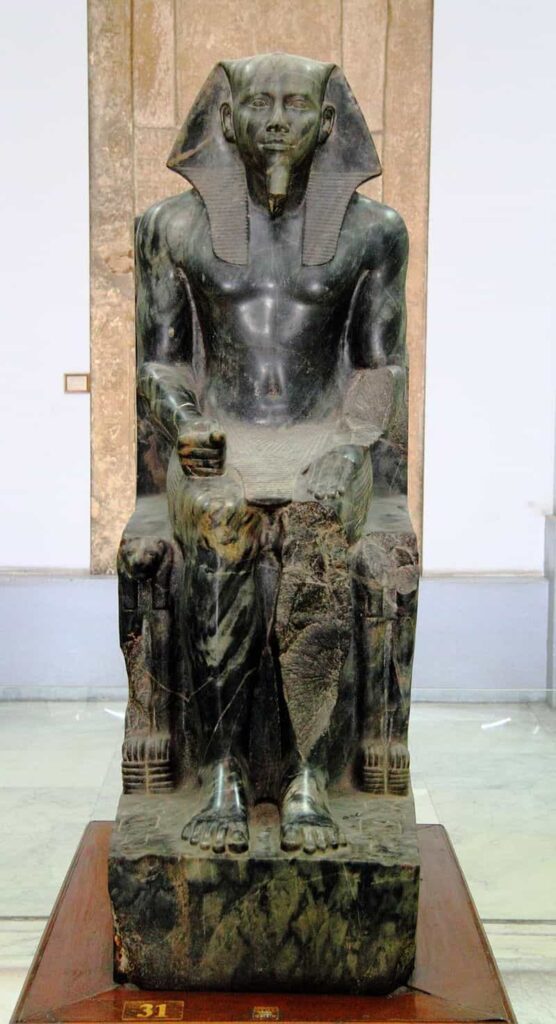
Khafre Enthroned, also known as the Seated Statue of King Khafre, is one of the masterpieces of Old Kingdom Egyptian art. Created during the reign of Pharaoh Khafre in the 4th Dynasty, the statue embodies the idealized image of Egyptian kingship: powerful, eternal, and protected by the gods.
Carved from diorite, the statue stands 168 centimeters (66 inches) tall and depicts Khafre seated majestically on a throne. It was discovered in 1860 by the French Egyptologist Auguste Mariette during excavations in the Valley Temple of Khafre at Giza. Today, it is displayed in the Egyptian Museum in Cairo.
Who Was Khafre?
Khafre was a 4th-Dynasty pharaoh of Egypt’s Old Kingdom and the son of King Khufu, builder of the Great Pyramid. He is generally dated to approximately 2558–2532 B.C. and is best known for constructing the second-largest pyramid at Giza.
Khafre’s pyramid complex included a large mortuary temple, a valley temple, and a long causeway connecting the two. The Great Sphinx of Giza is also generally associated with his reign, although the exact circumstances of its construction remain a subject of scholarly discussion.
Description of the Statue
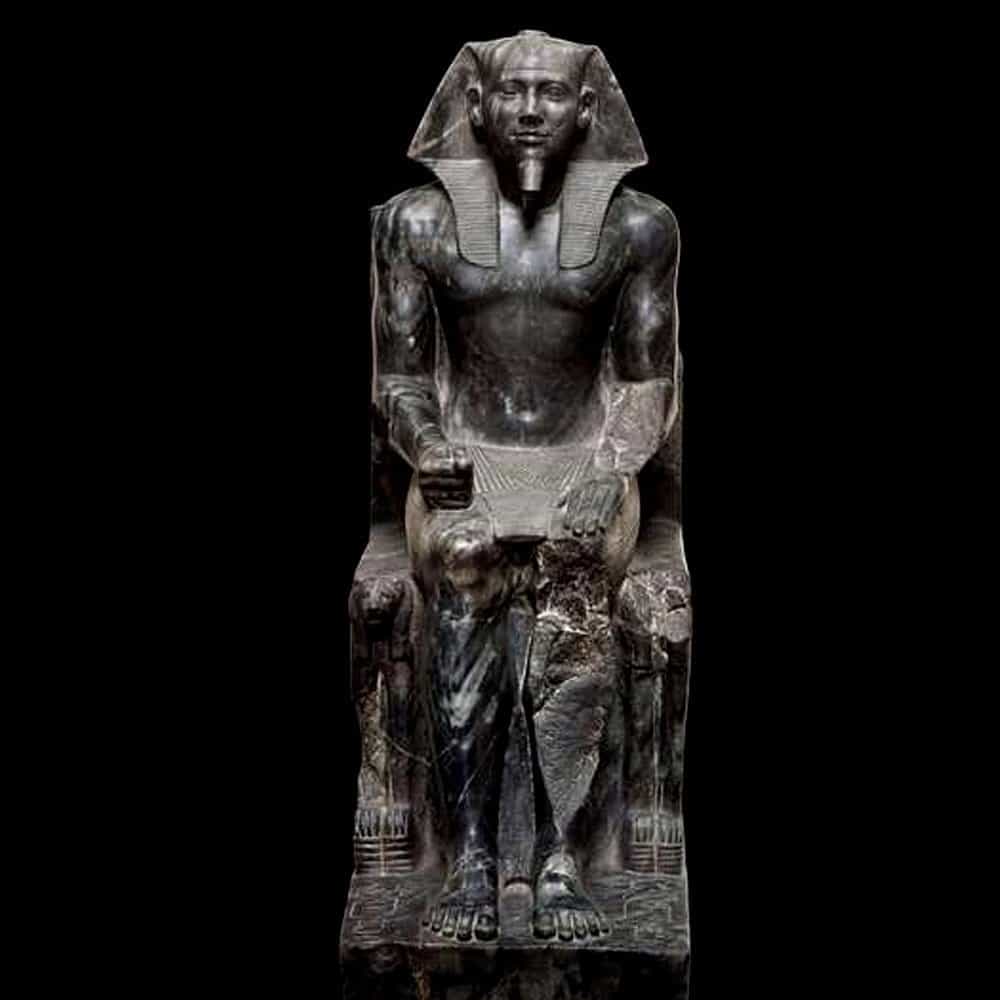
Khafre is shown seated on a throne in the traditional pose of an Egyptian king. His body is presented according to the conventions of royal Egyptian art, with an idealized face, broad shoulders, and a youthful, powerful physique.
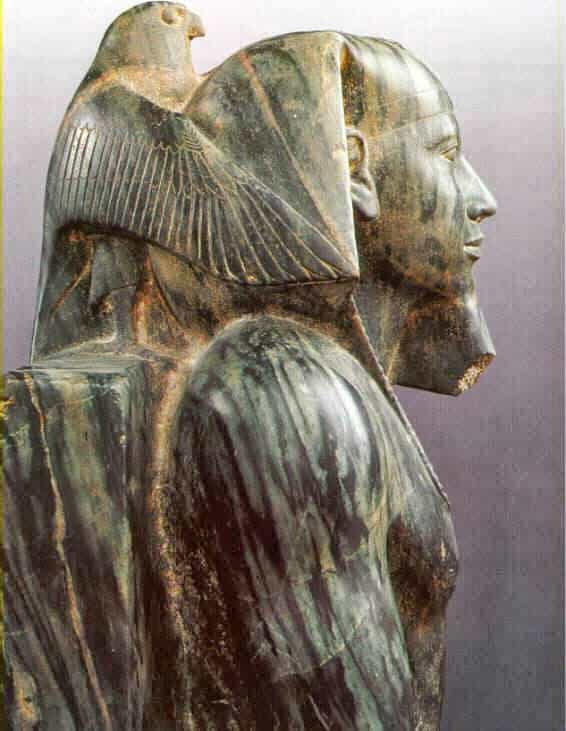
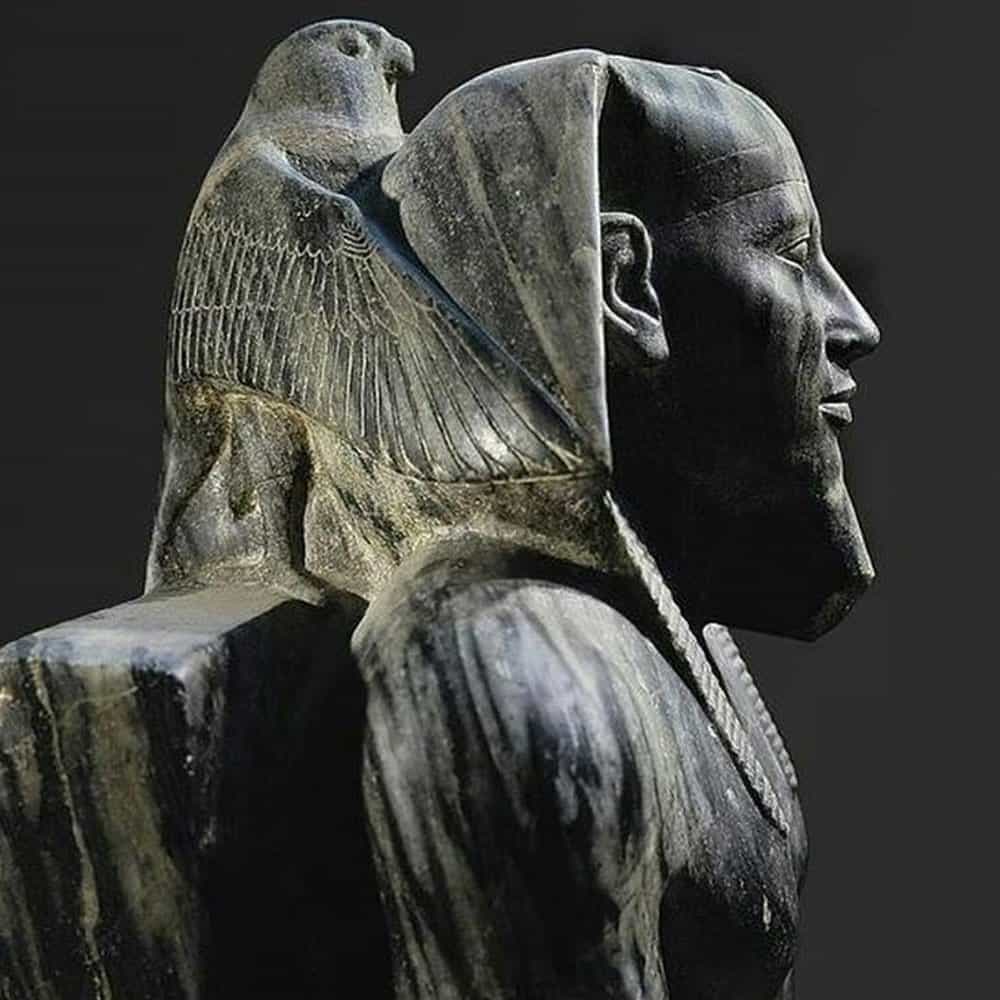
He wears the nemes headdress with a royal uraeus on his forehead and the traditional false beard, both symbols of Egyptian kingship. His torso is bare, while a pleated royal kilt covers the lower part of his body.
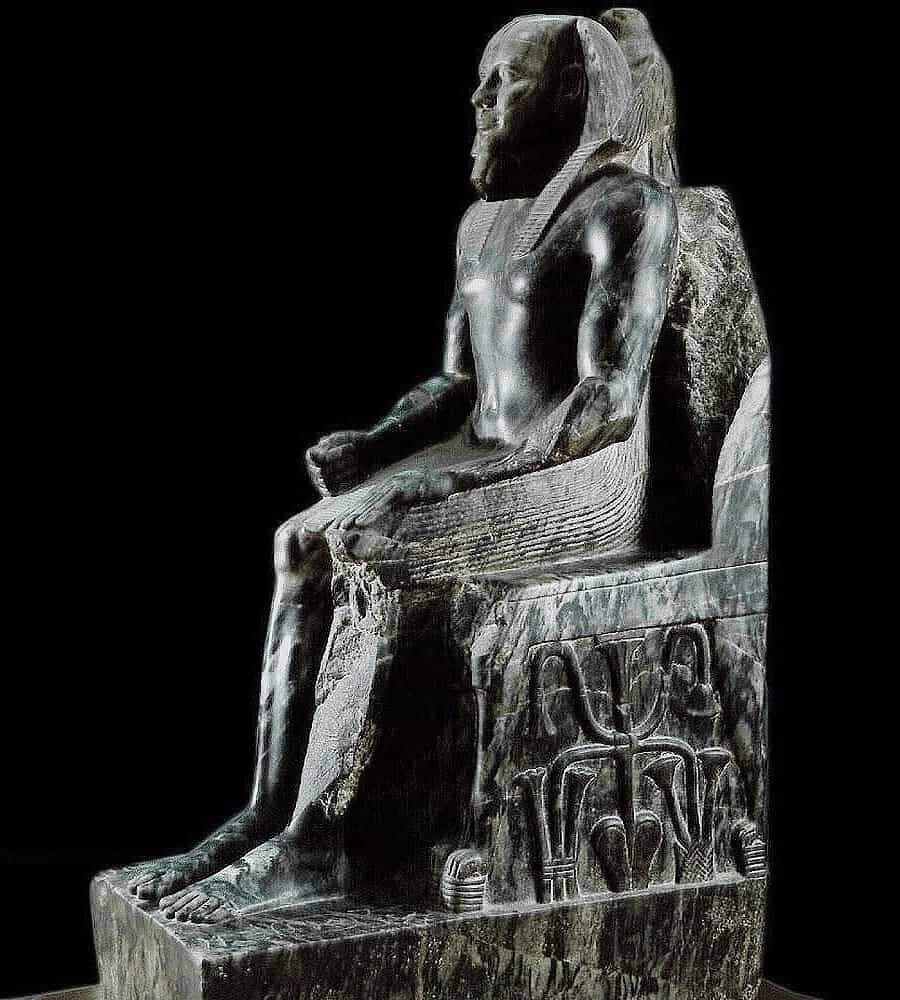
His arms rest close to his sides, with one hand clenched into a fist and the other lying open on his thigh. His legs are placed together, while his bare feet rest firmly on the base of the throne.
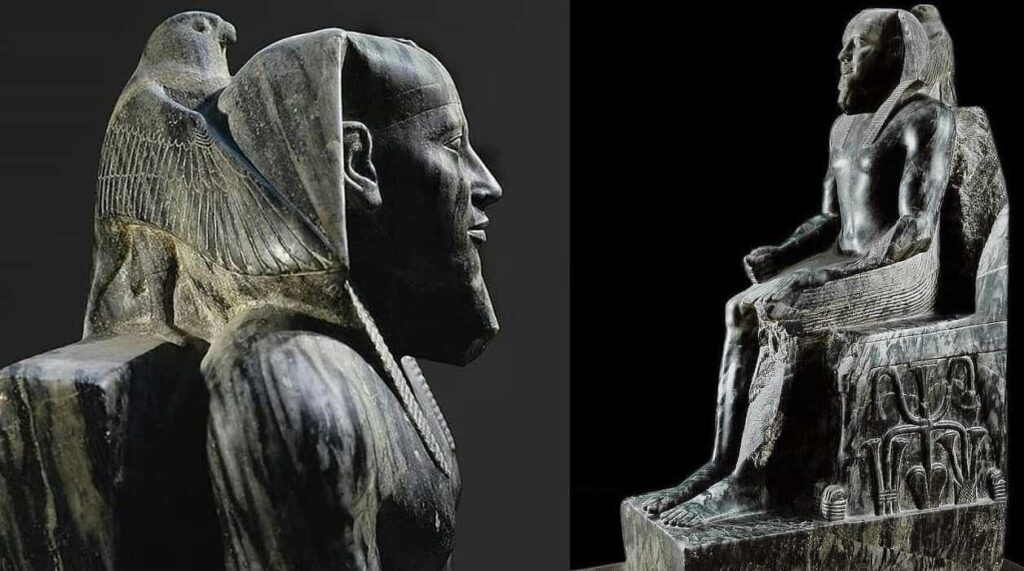
Behind Khafre’s head is a falcon representing the god Horus, whose outstretched wings appear to protect the king. This divine presence reinforces the connection between the pharaoh and the gods and emphasizes the king’s role as the divinely sanctioned ruler of Egypt.
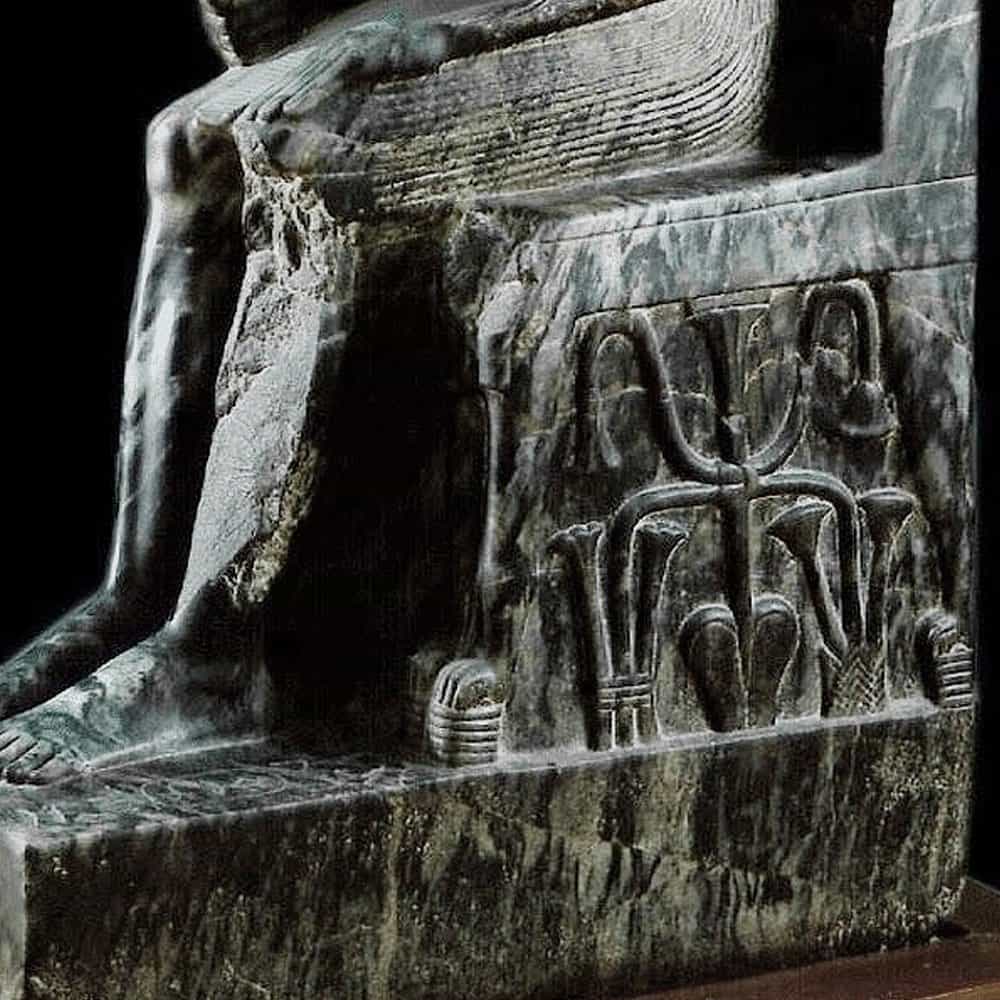
The throne itself is equally symbolic. Its sides are decorated with the sema-tawy, the traditional symbol representing the union of Upper and Lower Egypt. The throne also incorporates lion imagery, reinforcing the king’s strength and authority.
The statue’s rigid posture, frontal orientation, idealized features, and carefully balanced proportions are characteristic of Old Kingdom royal sculpture. Rather than portraying Khafre as an ordinary human being, the sculptor presents him as an eternal king whose authority transcends earthly life.
A Symbol of Eternal Kingship
Khafre Enthroned is far more than a portrait. Every element of the sculpture contributes to its message of royal power, divine protection, stability, and eternity.
The idealized face suggests a king beyond the effects of age, while the imposing throne and protective Horus falcon emphasize his divine status and authority. Together, these elements create one of the most powerful surviving representations of an Egyptian pharaoh.
Today, Khafre Enthroned remains one of the Egyptian Museum’s most celebrated masterpieces, offering a remarkable glimpse into the artistic ideals and religious beliefs of Egypt’s Old Kingdom.