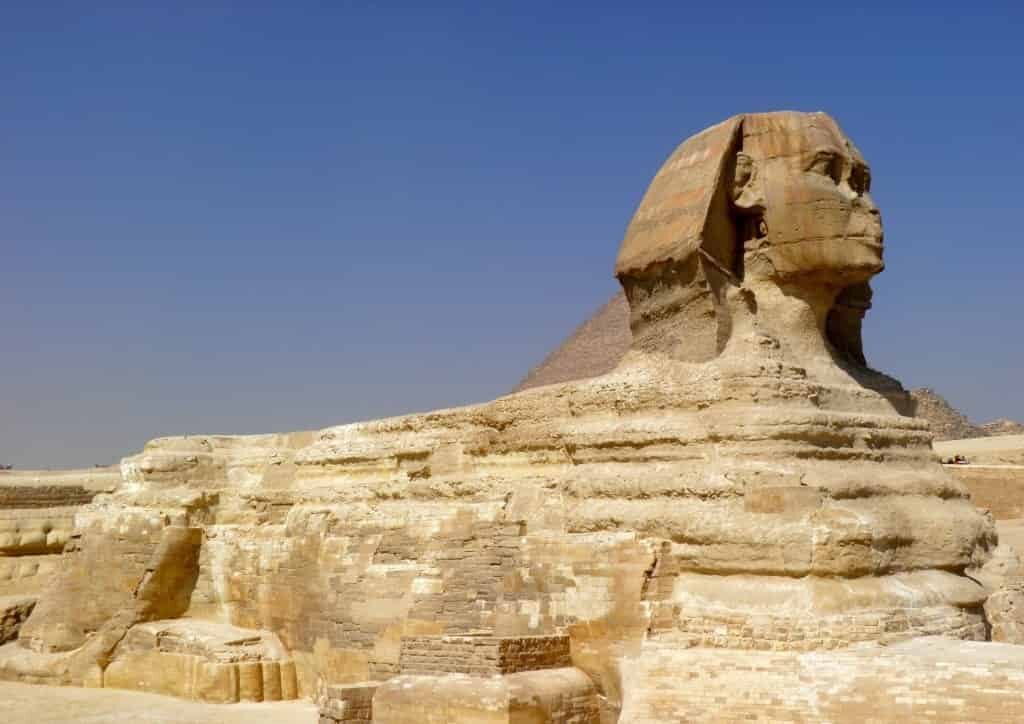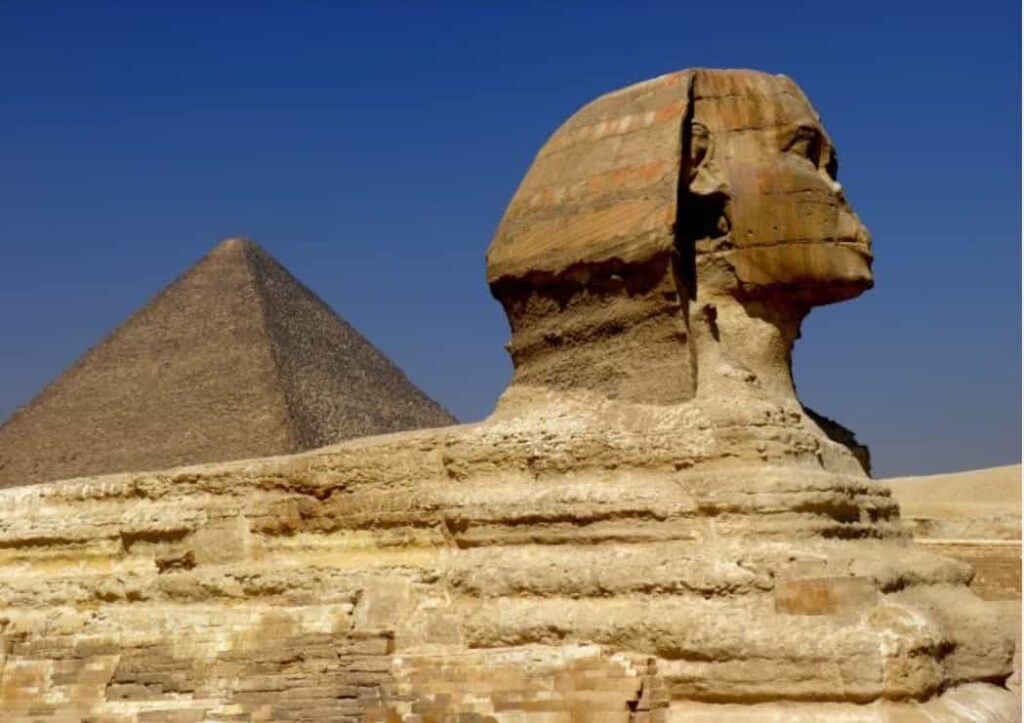
Situated on the Giza Plateau, on the west bank of the Nile River, stands the mysterious Great Sphinx of Giza.
Carved from a massive outcrop of limestone, this monumental sculpture measures approximately 240 feet (73 meters) long and 66 feet (20 meters) high. It is one of the largest and oldest monuments in the world and continues to fascinate Egyptologists and visitors alike with the mysteries it still holds.
1- When Was the Great Sphinx Built?
Although debate continues regarding its exact date of construction, most Egyptologists agree that the Great Sphinx was built around 2500 BC during the reign of Pharaoh Khafre, the builder of the Second Pyramid of Giza.
However, some alternative theories suggest a much earlier date, proposing that the monument may be thousands of years older—possibly dating back as far as 10,000 BC. These theories remain highly controversial and are not accepted by mainstream scholarship.
2- What Was the Sphinx Originally Called?
The name “Sphinx” came into use during classical antiquity. Unfortunately, it is impossible to know what the monument was called when it was originally built, as no surviving Old Kingdom inscription records its original name.
What we do know is that during the New Kingdom it was known as Hor-em-akhet, meaning “Horus of the Horizon.”
The Greek sphinx was a mythological creature with the body of a lion, the head of a woman, and the wings of an eagle. Egyptian sphinxes, by contrast, were typically wingless and usually depicted with a male head.
3- The Workers Who Built the Sphinx Ate Like Kings
A long-standing myth claims that the builders of Egypt’s monuments were slaves driven by brutal overseers. Excavations led by Egyptologist Mark Lehner tell a different story.
Evidence from workers’ settlements shows that laborers were well-fed and received substantial rations, including high-quality beef, mutton, and goat meat. These workers were skilled laborers who played a vital role in constructing the royal monuments at Giza.
4- Centuries Buried Beneath the Sand
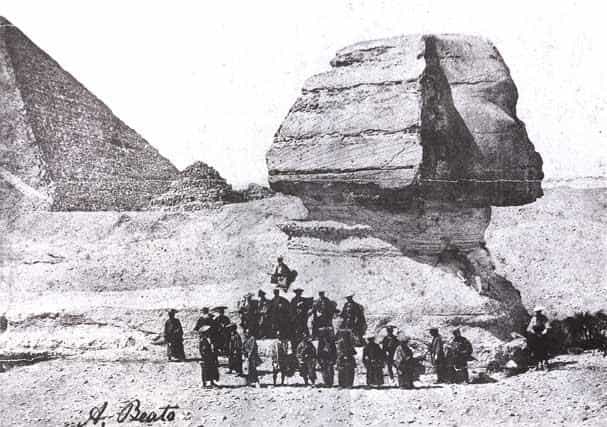
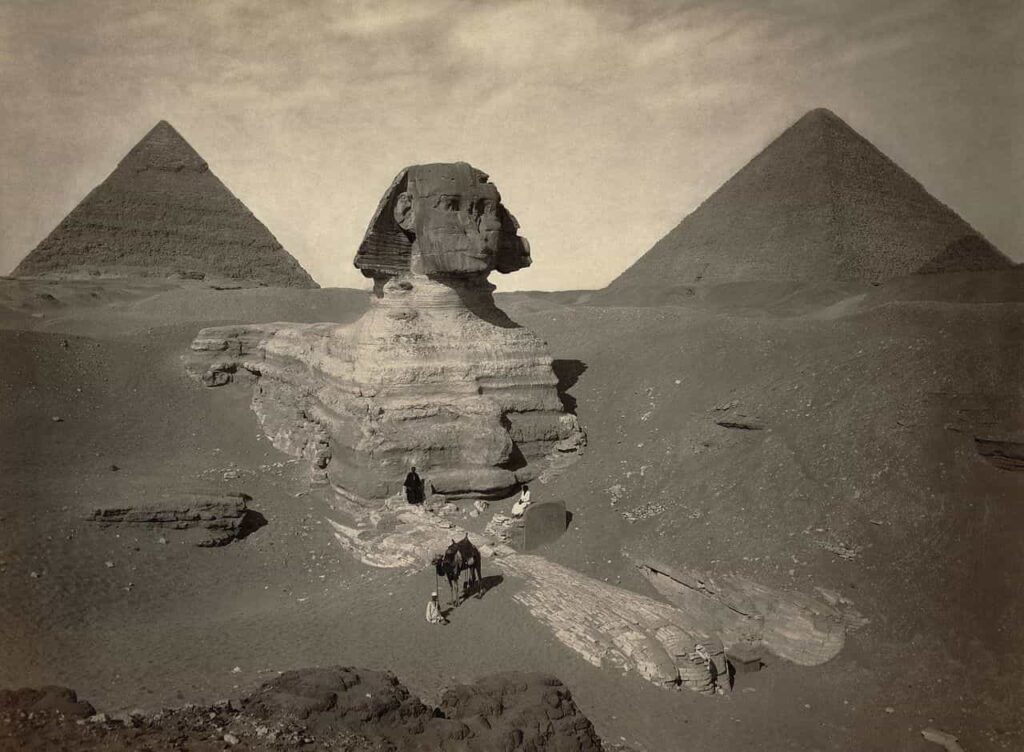
Throughout much of its history, the Great Sphinx has been buried by desert sands.
The first known large-scale restoration took place during the reign of Thutmose IV, when the monument was almost completely covered. Over the centuries, the sands returned and repeatedly engulfed the Sphinx.
It was not until the 1920s that the monument was fully excavated and revealed once again.
5- Did Napoleon Order the Destruction of the Sphinx’s Nose?
The missing nose of the Great Sphinx has inspired countless legends.
One of the most famous claims is that Napoleon Bonaparte’s soldiers shot it off during their Egyptian campaign. However, drawings made by the Danish explorer Frederic Louis Norden in 1738 clearly show the Sphinx without its nose—decades before Napoleon was born in 1769.
Other stories blame British troops or the Mamluks.
A more widely cited account comes from the 15th-century Arab historian al-Maqrizi, who wrote that a Sufi Muslim named Muhammad Sa’im al-Dahr damaged the nose after seeing local people make offerings to the Sphinx. According to the account, he was later executed for vandalism.
6- The Removable Beard
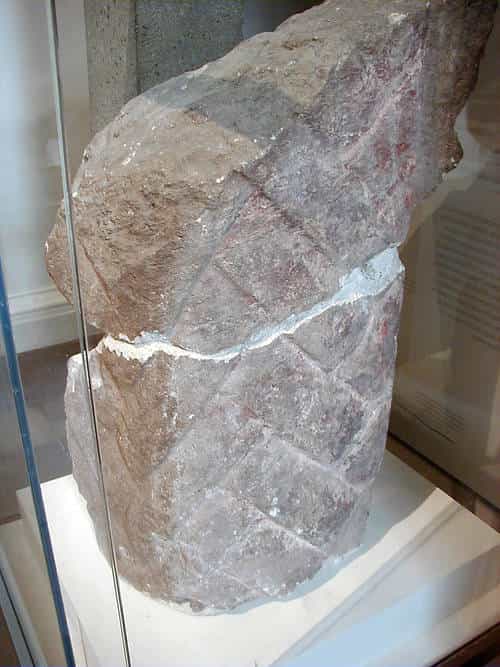
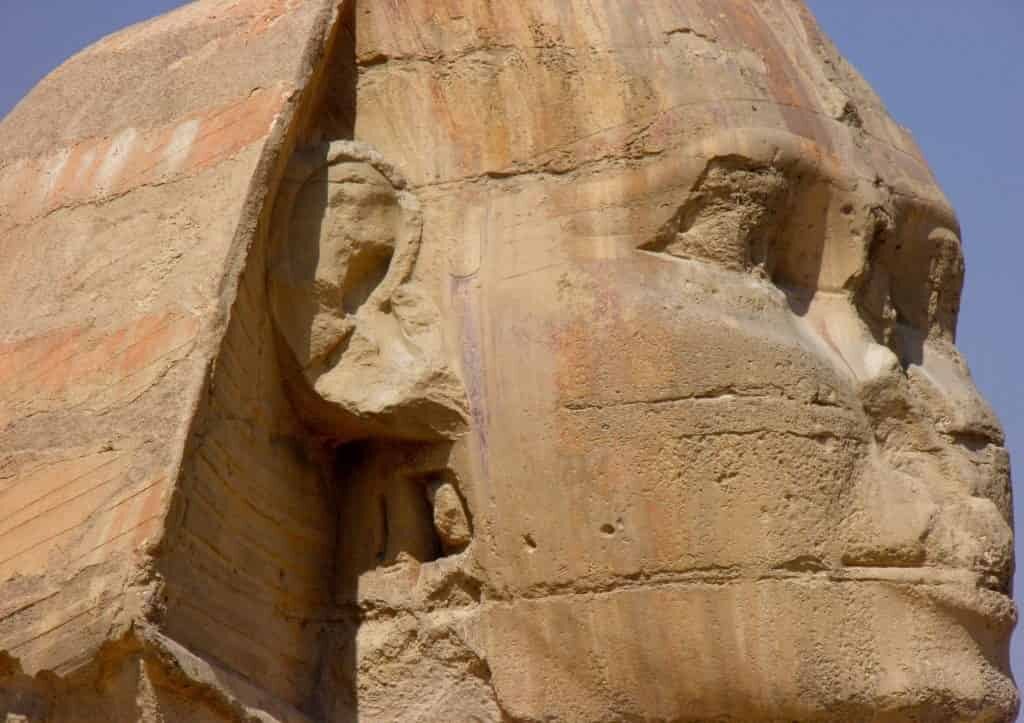
For centuries, the Great Sphinx wore a ceremonial beard, parts of which eventually broke away.
French Egyptologist Vassil Dobrev has argued that the beard was not part of the original sculpture. When it detached, it caused no significant damage to the chin, suggesting it was added later.
Many scholars believe the beard may have been installed during restoration work carried out under Thutmose IV in the 14th century BC.
Today, fragments of the beard are preserved in the British Museum.
7- The Colorful Sphinx
The Great Sphinx was not always the sandy color we see today.
Originally, it was painted in bright colors. Traces of red pigment remain visible on parts of the face, while evidence of blue and yellow pigments has been found on sections of the body.
These remnants offer a glimpse into how vibrant the monument once appeared.
8- The Dream of Thutmose IV
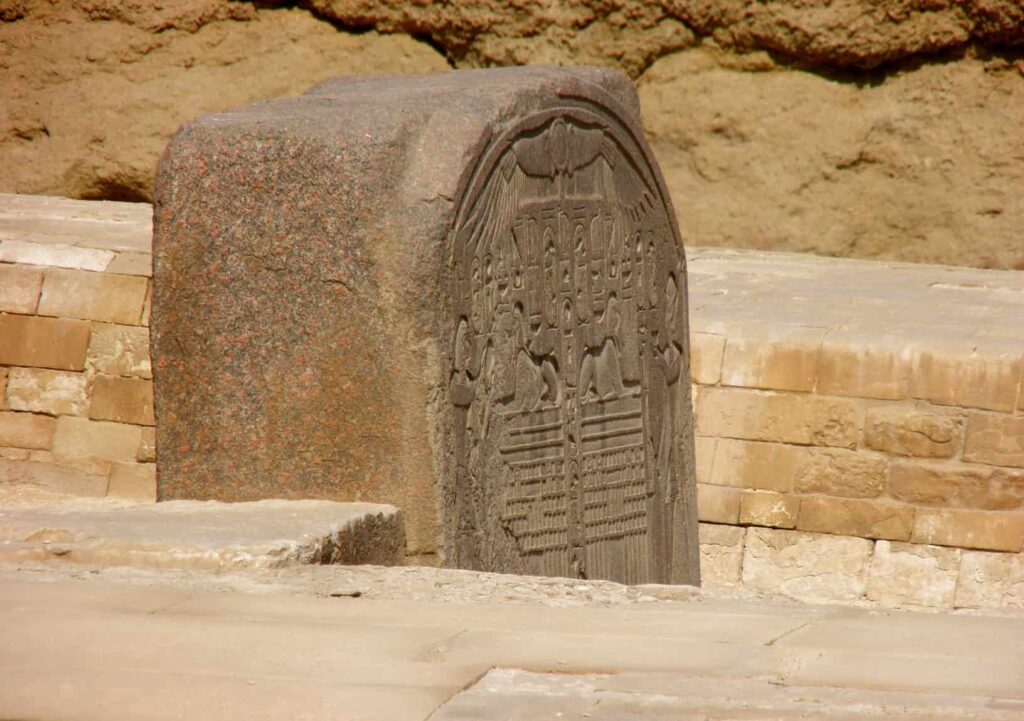
Between the paws of the Great Sphinx stands a granite monument known as the Dream Stele.
The inscription records a dream experienced by Prince Thutmose, who later became Pharaoh Thutmose IV. In the dream, the Sphinx spoke to him, promising kingship if he cleared away the sand that had buried the monument.
Motivated by this vision, Thutmose ordered the excavation of the Sphinx, creating what is considered the earliest documented restoration and excavation project associated with the monument.
9- More Than a Million Sunrises
The Great Sphinx faces east, directly toward the rising sun.
If the monument is approximately 4,500 years old, it has witnessed well over one million sunrises during its remarkable existence—a silent observer of thousands of years of Egyptian history.
10- The Sphinx’s Tail
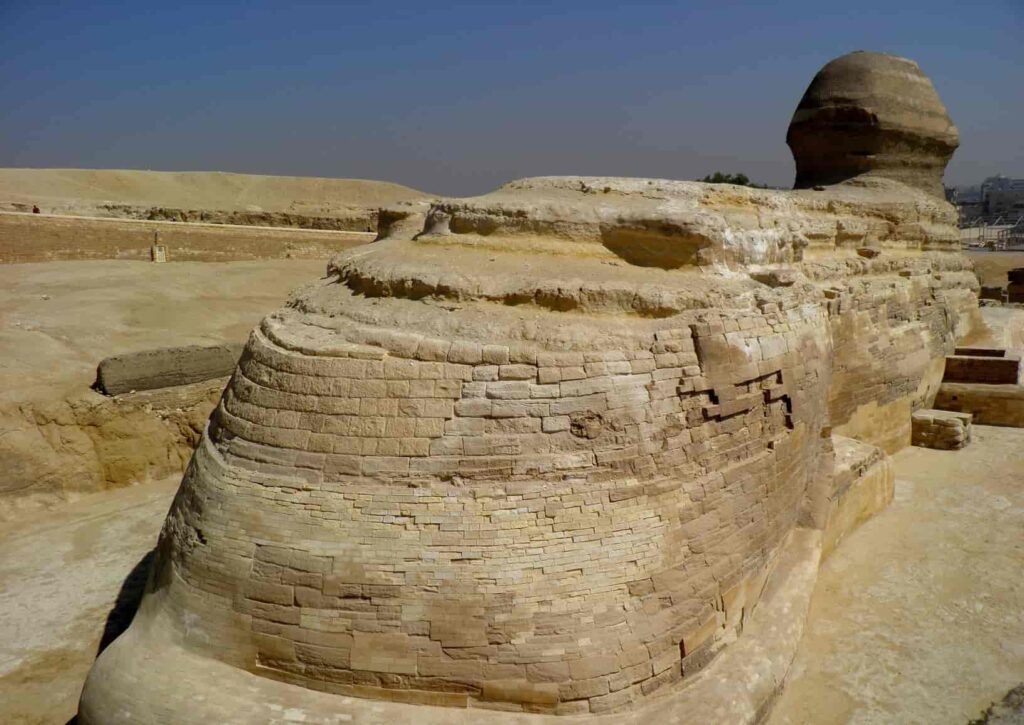
Because the Great Sphinx has the body of a lion, it naturally has a tail as well.
Many visitors are surprised to discover that the tail is not simply stretched behind the body. Instead, it curves elegantly around the monument’s right rear flank in a distinctive coiled shape, adding another fascinating detail to this iconic masterpiece.