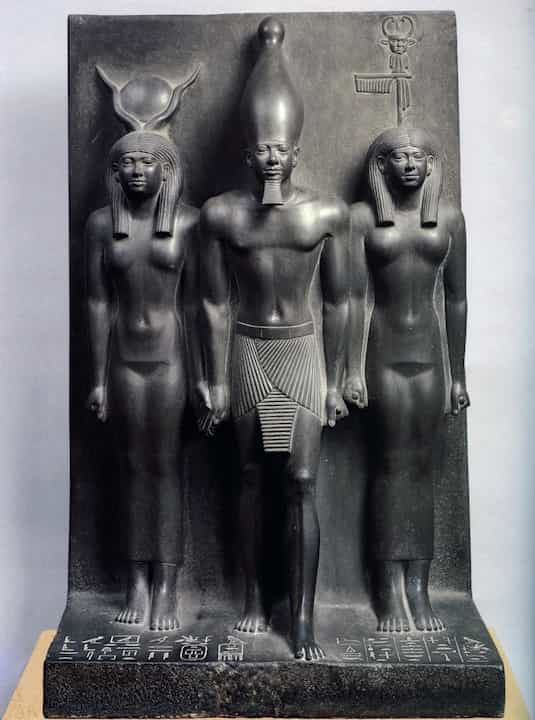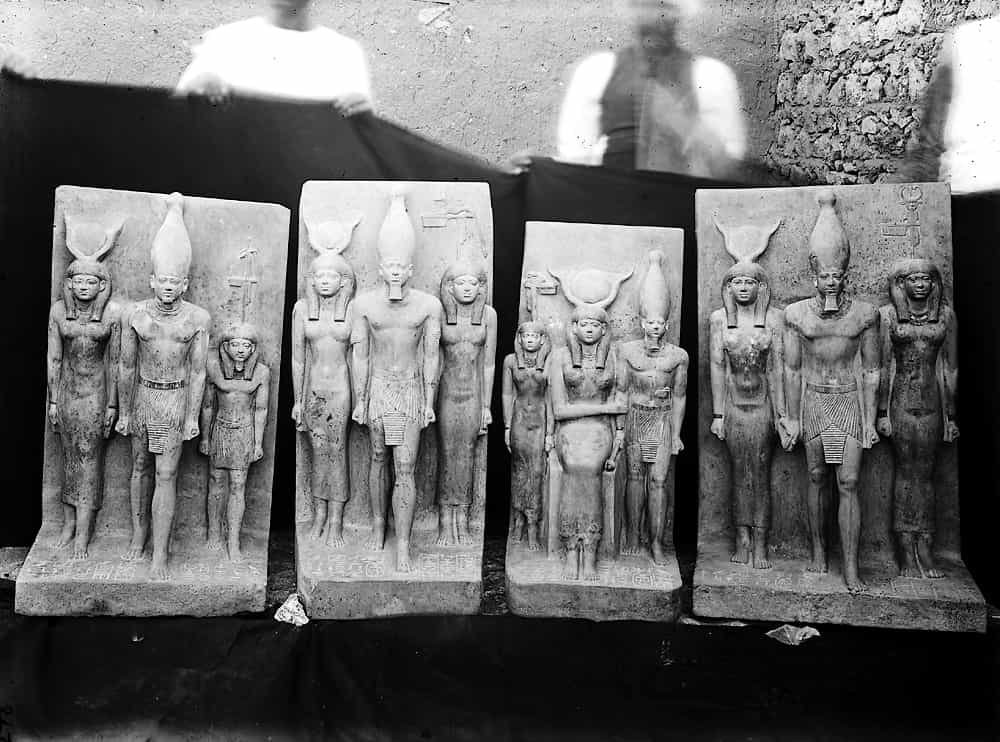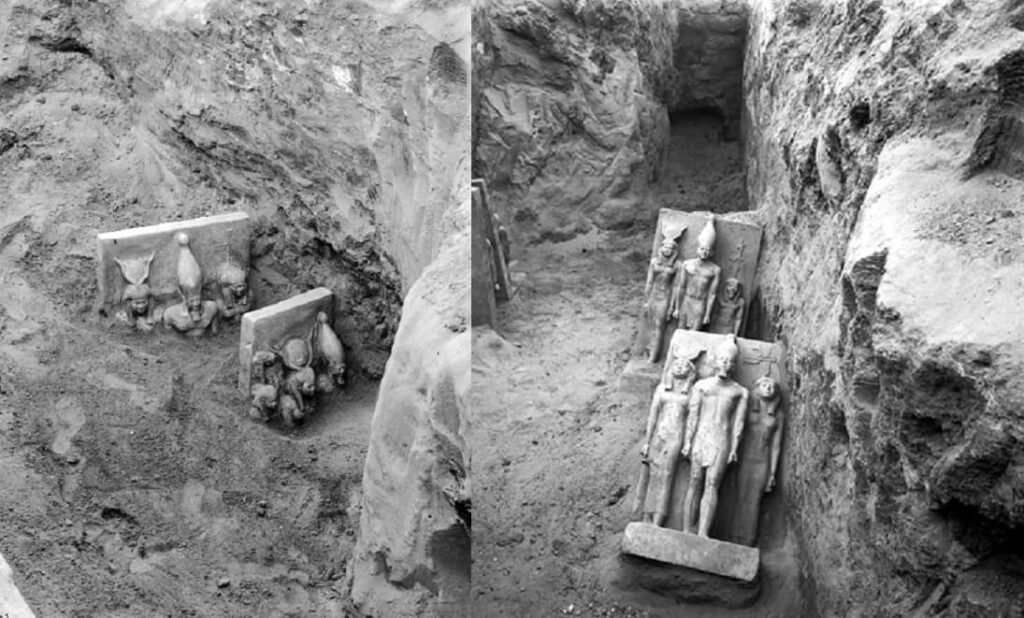
In 1908, George Reisner discovered eight “triads” depicting Pharaoh Menkaure, the goddess Hathor, and several provinces of Ancient Egypt.
Statues Everywhere
Menkaure’s pyramid had already been explored in 1834 by the British explorer Richard Vyse. Therefore, George Reisner focused on investigating other aspects of the complex. His investigations soon bore fruit. Next to the eastern face of the pyramid, Reisner located the Upper Temple.
Fragments of a colossal seated alabaster statue of the Pharaoh were found here, along with the remains of the causeway that linked this building with the Lower or Valley Temple (which has not yet been found). This was where the purification rites of the king’s mummy took place.
Reisner also discovered the funerary chapels of the three satellite pyramids belonging to Menkaure’s wives and some tombs of funerary priests in charge of the royal cult.
In June 1908, after conducting some sounding, Reisner turned his attention to discovering the remains of the Lower Temple of Menkaure. It was a raw brick construction with a limestone foundation, which gave the impression of having been finished in a hasty manner, perhaps due to the unexpected death of the king.
At the eastern entrance, a vestibule with four columns – flanked by some rooms that looked like storerooms – led to a wide patio that gave access to the offering room, with six columns, and to the sanctuary itself, next to which some rooms opened.
It was in these rooms that Reisner made a sensational discovery in July 1908. Joseph Lindon Smith, the cartoonist for the expedition, narrates the moment of discovery: “I myself shared with Reisner the exciting opening of each of those rooms full of sculptures. Two alabaster portraits of the king, four complete statues, and the greywacke triad”.
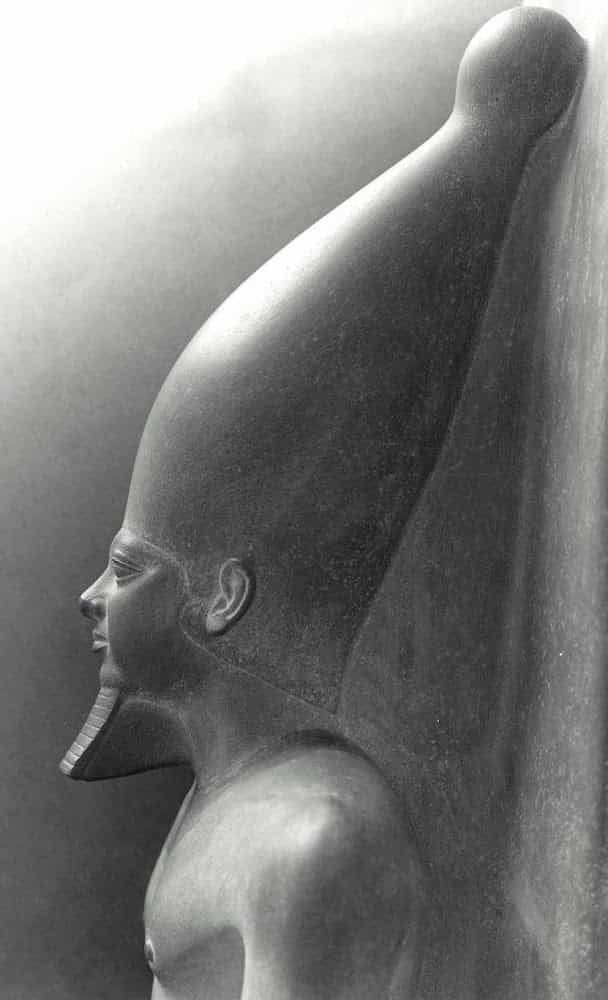
Thus, to the astonishment of the archaeologists, magnificent sculptural groups emerged from the rubble: eight greywacke sculptures (a type of sandstone), each made up of three characters: the pharaoh wearing the white crown of Upper Egypt, the goddess Hathor with her characteristic headdress with two horns and the solar disk, and the personification of a nome or province of ancient Egypt.
Four of these sculptures, which were called triads, were fragmented and incomplete, but four others were found complete and in an excellent state of preservation. Their function is uncertain, although they possibly had both a cult and a political component, a way of indicating that Menkaure was the lord of the whole country.
Masterpieces
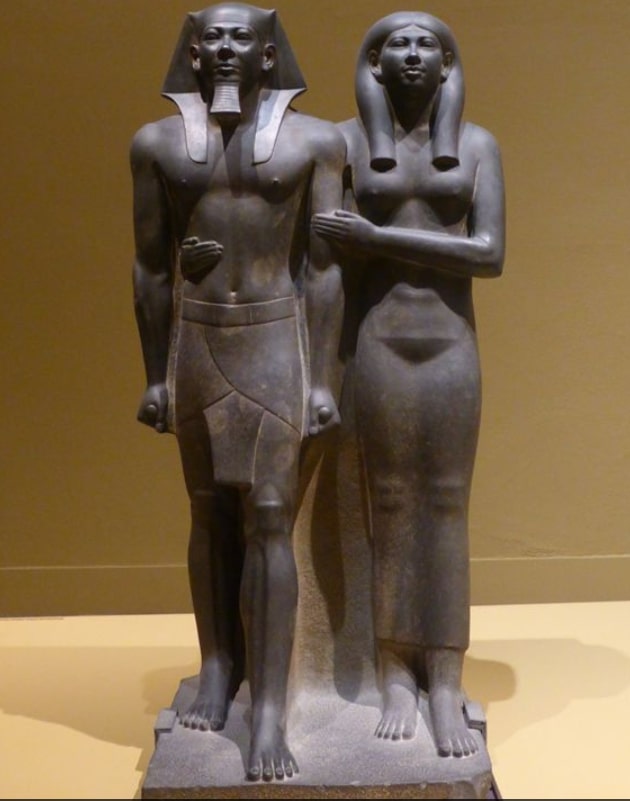
When Reisner believed that the Menkaure Valley Temple had already revealed all its secrets, another complete group of sculptures came to light on January 8, 1910: a representation of the Pharaoh, wearing a nemes or royal scarf, accompanied by a woman who he is embraced by, possibly his wife, Queen Kamerenebty.
Unfortunately, the artist who sculpted this magnificent piece never inscribed the names of those represented, so we cannot know for sure if she is the Great Royal Wife of Menkaure, as is generally believed.
Source: Carme Mayans, National Geographic