The burning question historians keep trying to answer.
For a historical figure as famous as Cleopatra VII, it is surprisingly difficult to know exactly what she looked like.
The last active ruler of Ptolemaic Egypt has inspired artists, poets, writers, and filmmakers for centuries, but the historical Cleopatra is often obscured by later artistic interpretations and repeated myths.
So, what evidence do we actually have?
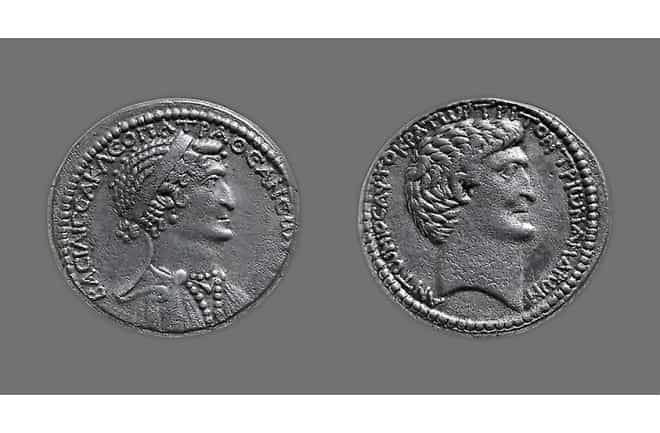
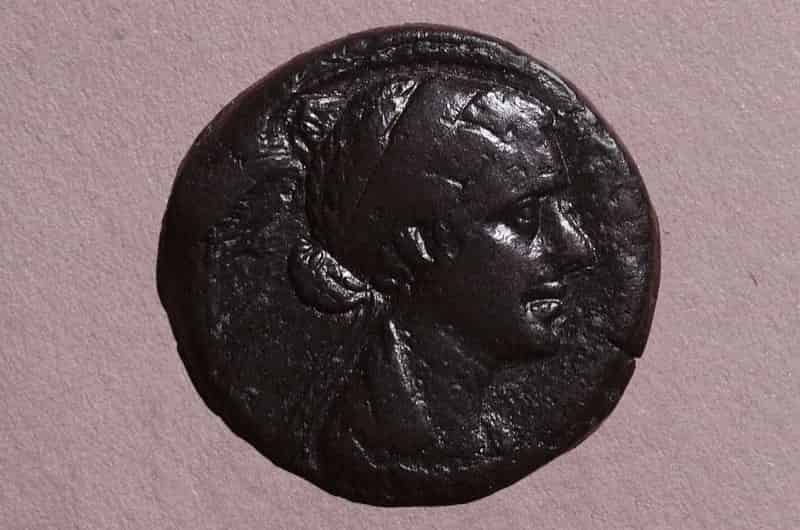
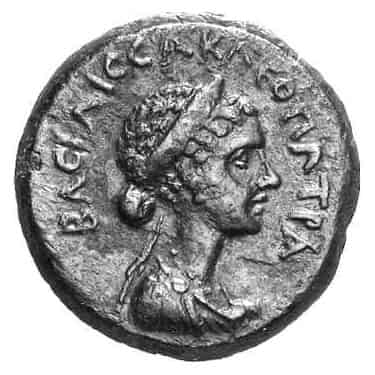
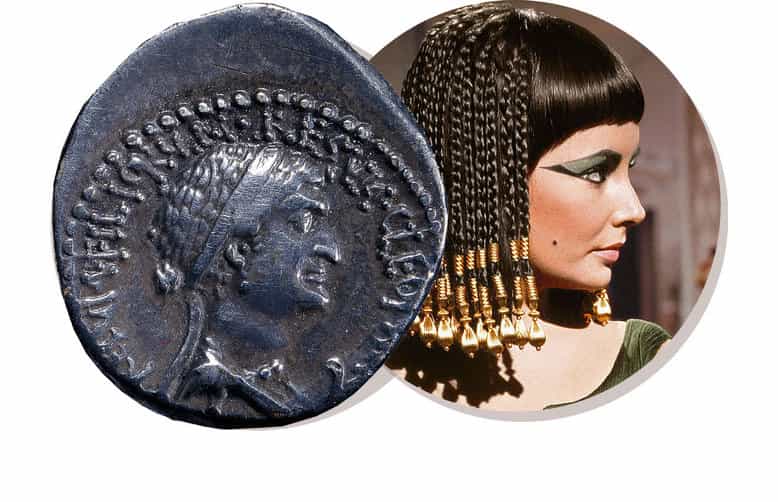
Surviving portraits of Cleopatra include coins issued during her lifetime, as well as several sculptures that have been attributed to her, although not all identifications are certain. Her coin portraits are particularly important because they were produced during her reign and show how she chose to present herself as queen.
The surviving portraits do not give us a single, perfectly consistent image. Cleopatra appears with a prominent, somewhat aquiline nose, a pointed chin, and her hair arranged in a royal style beneath a diadem. Different coin portraits vary in their details, however, reflecting both artistic conventions and the political purposes of royal portraiture.
Cleopatra belonged to the Ptolemaic dynasty, which descended from Ptolemy I, one of Alexander the Great’s Macedonian generals. The dynasty ruled Egypt from the early third century BC until Cleopatra’s death in 30 BC.
This does not mean, however, that we can confidently reconstruct Cleopatra’s appearance simply by calling her “Greek” or “Egyptian.” The Ptolemaic kingdom was a complex multicultural society, and the interaction between Greek and Egyptian traditions was an important feature of the period. Cleopatra herself was a member of the Macedonian Greek ruling dynasty, but the precise ancestry of her mother and some earlier generations is not fully known.
Some sculptures have been proposed as portraits of Cleopatra. The Metropolitan Museum of Art, for example, describes one Ptolemaic queen as “perhaps Cleopatra VII,” while noting that the identification is uncertain.
Modern reconstructions, including those associated with Egyptologist Dr. Sally-Ann Ashton, have attempted to visualize Cleopatra by combining archaeological evidence with interpretations of her possible ancestry. But such reconstructions should be understood as informed hypotheses—not photographs of a face we can know with certainty.
And perhaps the biggest misconception is that Cleopatra’s appearance explains her historical success.
Ancient sources themselves offer a more complicated picture. Plutarch, writing more than a century after Cleopatra’s death, reported that her beauty was not necessarily exceptional compared with other women. What distinguished her, he said, was her charm, intelligence, conversation, and ability to communicate in many languages.
Her appearance undoubtedly became an important part of her later legend. But Cleopatra was far more than a beautiful queen. She was an extraordinarily capable political operator who ruled Egypt during one of the most turbulent periods of the ancient Mediterranean world.
We may never know exactly what Cleopatra looked like—but we know that her greatest power was not simply her face.