The mummy of Pharaoh Amenhotep I, who ruled during Egypt’s 18th Dynasty (c. 1525–1504 BC), is one of the most remarkable royal mummies ever discovered. Unlike most ancient Egyptian royal mummies, it remained unopened for more than a century after its discovery.
Amenhotep I was buried twice. The first burial took place after his death, while the second occurred during the Twenty-first Dynasty (c. 1070–945 BC), when priests reburied him at Deir el-Bahari to protect his remains from tomb robbers.
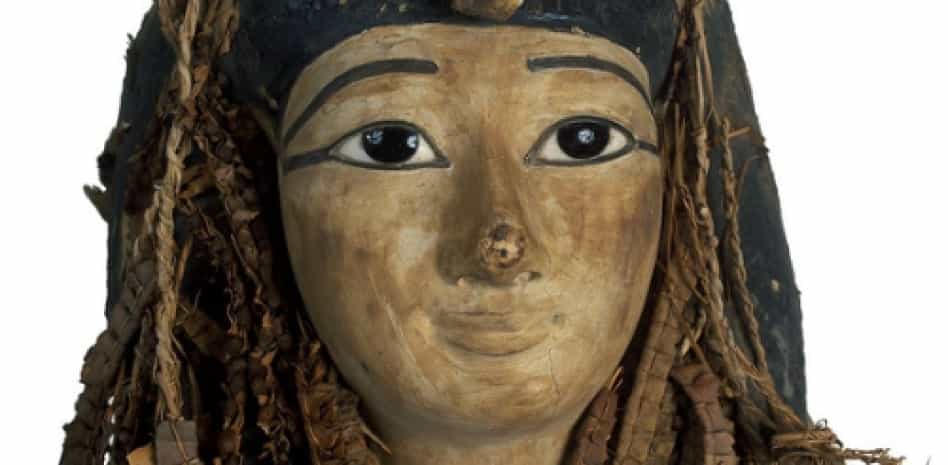
For nearly 3,000 years, the pharaoh rested undisturbed—until his mummy was discovered in 1881. Remarkably, it remained completely wrapped. While nearly all other royal mummies found during the 19th and 20th centuries were unwrapped for examination, Amenhotep I’s mummy was left intact. Scholars were reluctant to disturb its beautifully preserved linen wrappings, floral garlands, and exquisite funerary mask.
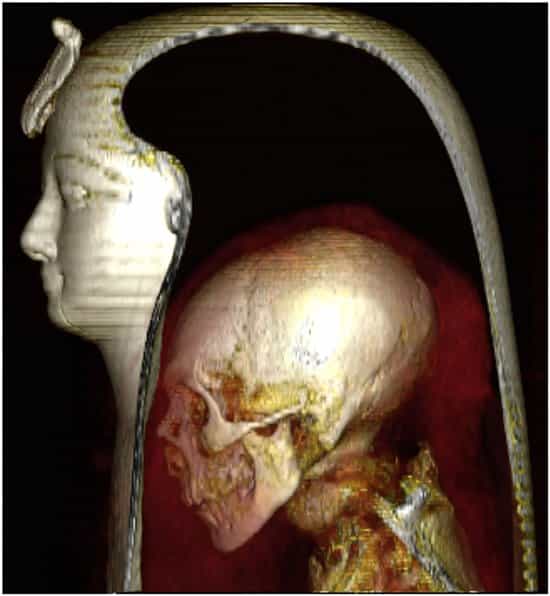
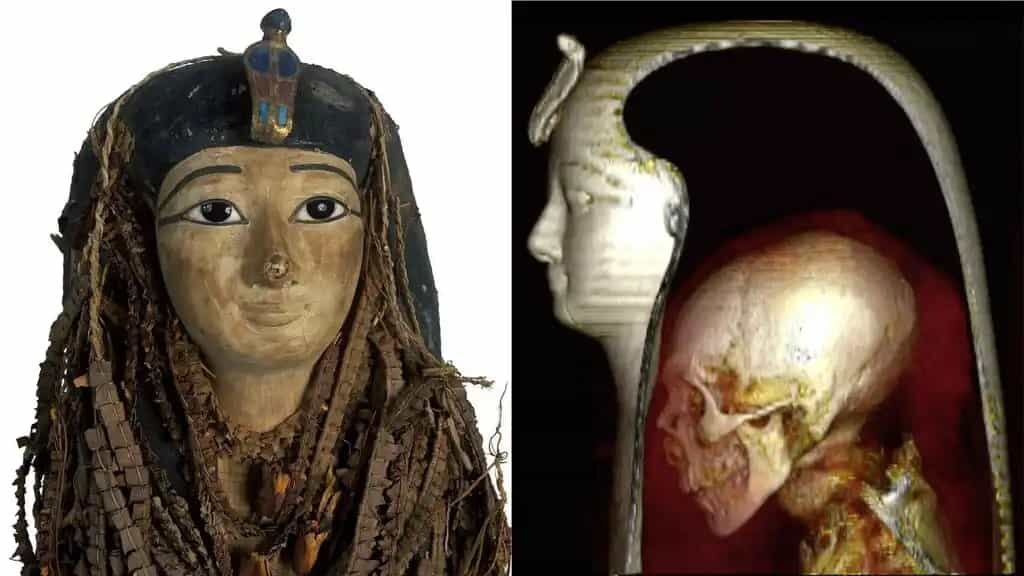
To uncover the secrets hidden beneath the wrappings, archaeologist Zahi Hawass and radiologist Sahar N. Saleem of Cairo University used advanced, non-invasive imaging techniques. Through computerized tomography (CT) scanning, they were able to digitally “unwrap” the mummy and study it in unprecedented detail without causing any damage.
The scans revealed that Amenhotep I died at approximately 35 years of age. He stood about 169 cm (5 ft 7 in) tall, was circumcised, and had teeth showing only minimal wear. The examination also confirmed that his internal organs had been removed through an incision in the left side of his abdomen.
One of the study’s most intriguing findings was that Amenhotep’s brain had not been removed—a practice that became more common in later periods of Egyptian mummification. The scans also revealed that his heart remained in place within his chest and that he was buried with around 30 amulets and pieces of jewelry, including a band of metal beads that may have been made of gold.
Researchers found evidence of extensive post-mortem damage, likely caused by ancient tomb robbers. However, the priests of the Twenty-first Dynasty appear to have carefully restored the mummy. They reattached the detached head and neck using resin-treated linen, repaired damage to the abdominal wall, placed protective amulets beneath the wrappings, and repositioned and wrapped the detached left arm alongside the body.
The mummy’s funerary mask is made of cartonnage and features stone-inlaid eyes. By digitally removing the mask and layers of wrappings, researchers were able to reconstruct the pharaoh’s appearance.
According to Sahar Saleem, Amenhotep I likely resembled his father, Ahmose I. He had a narrow chin, a small and narrow nose, curly hair, and slightly protruding upper teeth.
While Ahmose I is celebrated for expelling the Hyksos and reunifying Egypt, Amenhotep I inherited a stable and prosperous kingdom. His reign was marked by peace and prosperity, and after his death, he was revered as a deity by later generations of Egyptians.
Source: Hawass, Z., & Saleem, S. N. (2021), Frontiers in Medicine.