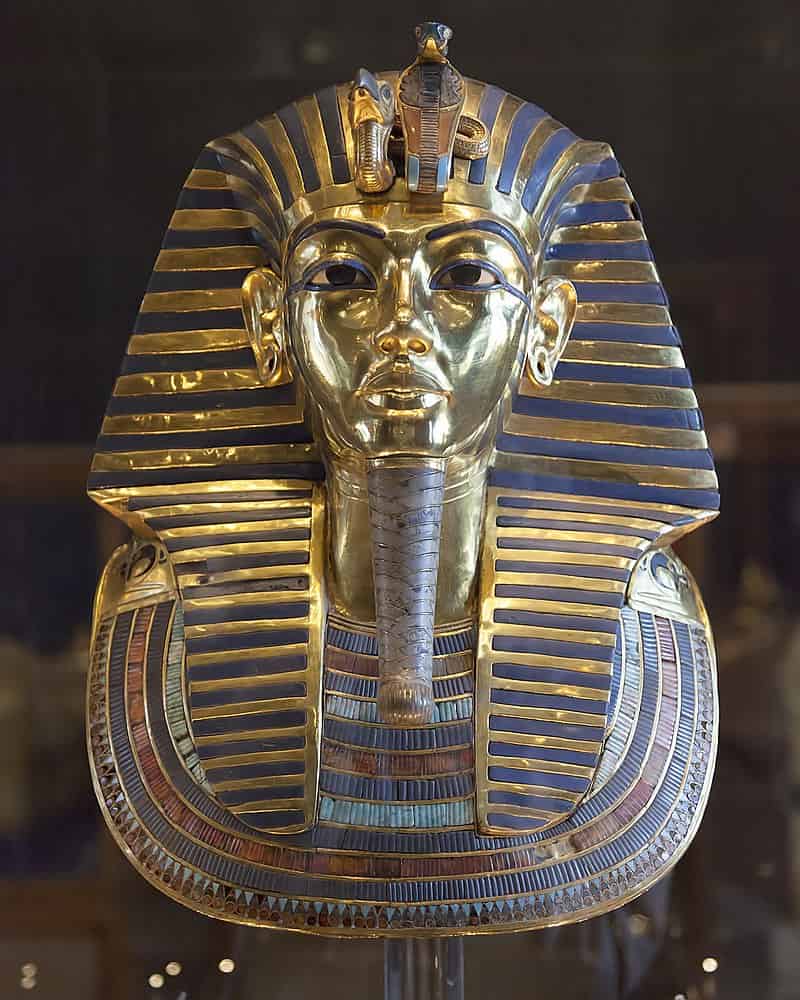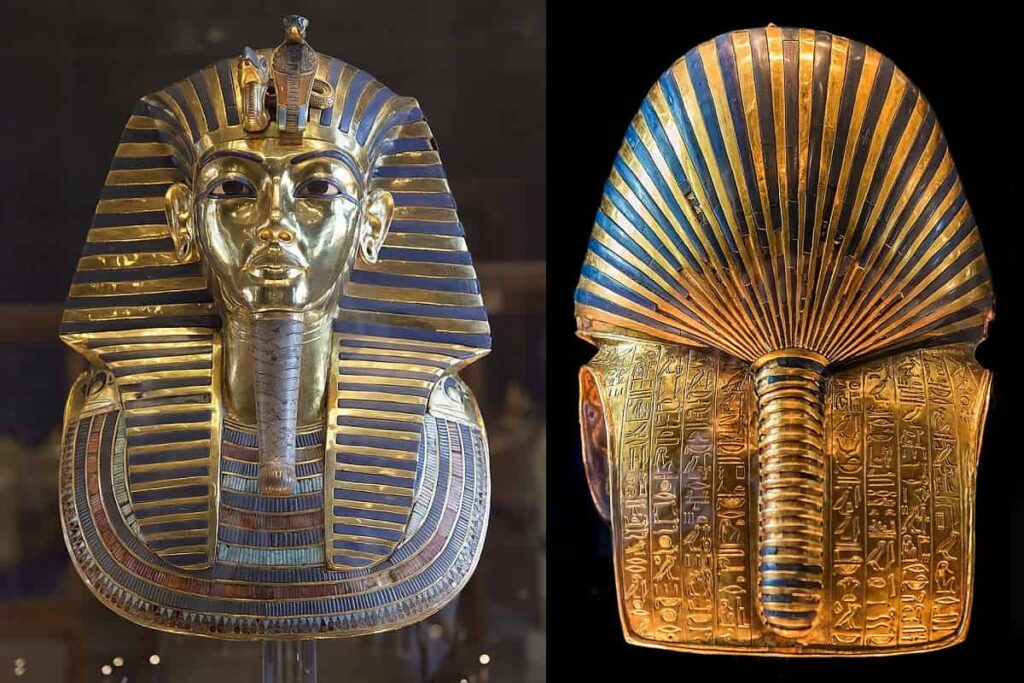
Tutankhamun’s famous gold funerary mask is one of the most recognizable masterpieces of ancient Egyptian art. Created to protect and transform the deceased king for the afterlife, the mask combines royal imagery, divine symbolism, precious materials, and funerary magic.
The mask was placed directly over the head and shoulders of Tutankhamun’s mummy inside his innermost coffin. It was uncovered by Howard Carter and his team on October 28, 1925, during the fourth excavation season of tomb KV62 in the Valley of the Kings. Carter had discovered the tomb itself three years earlier, in November 1922.
The mask depicts Tutankhamun with an idealized but highly individualized royal face. Its purpose was not simply to preserve the king’s likeness. In ancient Egyptian funerary belief, a recognizable image could help the deceased’s spiritual elements identify and reunite with the body, while the mask’s divine imagery and inscriptions provided magical protection. The Global Egyptian Museum describes the mask as an example of the highest artistic and technical achievements of the New Kingdom.
What Does Tutankhamun’s Mask Represent?
The mask presents Tutankhamun as an eternal, divine king. He wears the striped nemes headdress and a false beard, both associated with Egyptian kingship and divine status.
On his forehead are the uraeus cobra of Wadjet and the vulture of Nekhbet. These two protective goddesses represented Lower and Upper Egypt respectively and symbolized the king’s rule over the unified Two Lands.
The mask’s face is calm and idealized, presenting the king not as a vulnerable human being but as an eternal ruler. Its divine associations are reinforced by the use of gold, a material closely associated with the gods in ancient Egyptian thought. Gold was valued for its resistance to corrosion and its resemblance to the enduring brilliance of the sun.
The mask therefore represents more than Tutankhamun’s physical appearance. It presents him as a divine and eternal king prepared for his transformation and existence in the afterlife.
Tutankhamun’s Gold Funerary Mask: Materials and Dimensions
The mask is made primarily of high-karat gold and consists of two sheets of gold that were hammered and joined together. It weighs approximately 10.23 kilograms (22.5 pounds) and measures about 54 centimeters high and 39.3 centimeters wide.
Its elaborate decoration includes gold, lapis lazuli, obsidian, quartz, carnelian, turquoise, and colored glass. The eyes are made from quartz and obsidian, while lapis lazuli is used for the eyebrows and cosmetic lines. The broad collar is richly inlaid and terminates in falcon heads.
The combination of gold and colorful inlays was not merely decorative. The materials contributed to the mask’s religious symbolism and transformed the king’s image into a powerful funerary object.
The Nemes Headdress and the Two Goddesses
The striped nemes headdress is one of the most recognizable symbols of ancient Egyptian kingship. On Tutankhamun’s mask, it frames his face and emphasizes his royal identity.
The forehead bears two powerful protective emblems:
- Nekhbet, the vulture goddess associated with Upper Egypt.
- Wadjet, represented by the rearing cobra or uraeus and associated with Lower Egypt.
Together, they symbolize the king’s sovereignty over Upper and Lower Egypt while also serving as divine protectors of the pharaoh.
The Face of Tutankhamun
One of the most remarkable features of the mask is the treatment of Tutankhamun’s face. The image is idealized according to royal artistic conventions while retaining recognizable features.
The same conception of the young king’s face appears elsewhere among the objects discovered in KV62. Howard Carter’s records describe the golden mask as being in the likeness of the king, with the royal headdress, eyes, beard, and symbols of Upper and Lower Egypt.
The mask therefore served as a permanent royal image, presenting Tutankhamun as an eternally youthful and powerful ruler rather than as a deceased young man.
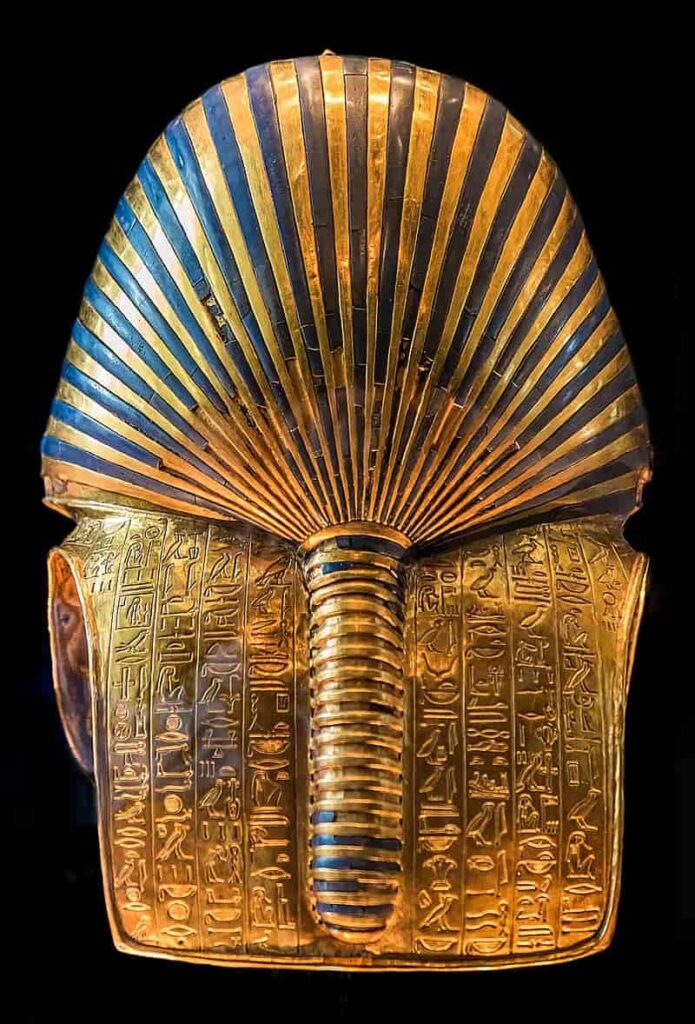
The Protective Spell on the Back of the Mask
Perhaps the most important part of the mask is not visible from the front.
The back and shoulders are inscribed with Spell 151B of the Book of the Dead, a funerary spell intended to protect the deceased. The text associates different parts of the deceased with various gods, effectively surrounding the king with divine protection.
The spell identifies parts of the body with deities and divine beings, including associations with Anubis, Horus, Ptah-Sokar, and the Ennead. Its purpose was to protect the deceased and ensure that no part of the body was left without divine guardianship.
This inscription reveals an essential aspect of ancient Egyptian funerary religion: the mask was not simply an artistic portrait. It was a magically activated object intended to protect the king and assist his transformation into an eternal being.
Why Is Tutankhamun’s Mask So Important?
Tutankhamun was not one of Egypt’s most powerful or long-reigning pharaohs. He ruled for roughly a decade and died while still a young man. Yet the extraordinary preservation of his tomb made him one of the most famous rulers of ancient Egypt.
The gold funerary mask became the most enduring symbol of that discovery. Its combination of royal imagery, divine protection, precious materials, and funerary inscriptions provides a remarkable insight into how ancient Egyptians understood kingship, death, resurrection, and eternal life.
Tutankhamun’s mask was therefore much more than a portrait of a young pharaoh. It was an image of the king transformed into an eternal, divinely protected ruler of the afterlife.